
The Queen Who Saw the Sea as Jepara’s Gateway to the World
Hello, Friends of Cita & Nesia!
This time, let us return to the northern coast of Java.
Our destination is Jepara.
Today, many people know Jepara for its beautiful woodcarving traditions.
But hundreds of years ago, Jepara was also connected to a very different world.
A world of ships.
Busy ports.
Traders.
Sea routes.
And powerful kingdoms.
In the sixteenth century, one remarkable woman stood at the centre of this maritime world.
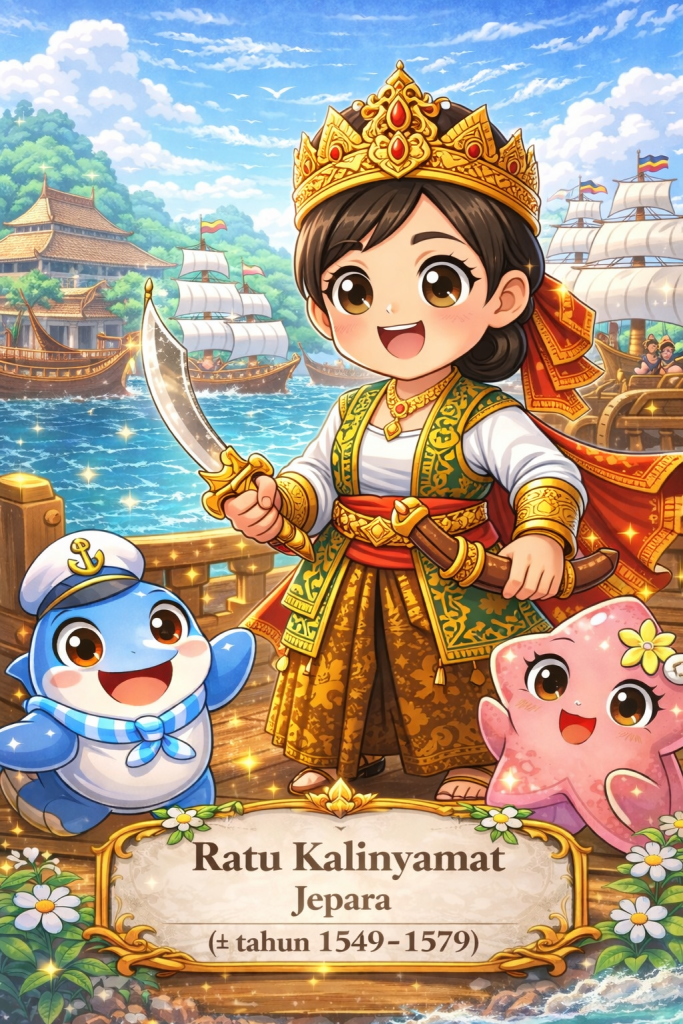
Her name was Ratu Kalinyamat.
She is also known in historical traditions as Retna Kencana.
And she became one of the best-known female rulers in the maritime history of Java.
A Queen from the Coast
Ratu Kalinyamat ruled Jepara during the sixteenth century.
Her world was deeply connected to the sea.
From Jepara, ships could travel towards other ports across Java and farther across the Nusantara.
Goods arrived.
Goods departed.
Sailors brought news from distant places.
And political relationships could stretch far beyond the shoreline.
For Ratu Kalinyamat, the coast was therefore not simply where land ended.
It was where connections began.
When Jepara Looked Towards the Sea
Imagine standing at a busy harbour hundreds of years ago.
There are no container ships.
No cranes.
No engines roaring across the water.
Instead, you might see large wooden vessels.
Sailors preparing ropes.
Merchants carrying goods.
Craftspeople repairing ships.
And people waiting for news from distant ports.
A harbour like Jepara was a meeting place.
People from different areas could exchange goods, knowledge, languages and ideas.
This meant that a strong coastal community needed more than a good location.
It needed ships.
Skilled people.
Trading relationships.
And leaders who understood the importance of the sea.
Ratu Kalinyamat became remembered as one of those leaders.
When the Portuguese Controlled Malacca
Farther west stood another important maritime centre:
Malacca.
By Ratu Kalinyamat’s time, Malacca was under Portuguese control.
This mattered because the Strait of Malacca was one of the most important maritime routes in the region.
Ratu Kalinyamat became involved in attempts to challenge Portuguese power there.
Historical accounts record that Jepara sent forces to support an attack on Portuguese Malacca in the 1550s.
Years later, in 1574, another large expedition from Jepara sailed towards Malacca.
The campaign did not succeed in taking the Portuguese fortress.
But think about what organising such an expedition required.
Ships had to be prepared.
People had to be organised.
Supplies had to be collected.
Routes had to be understood.
And cooperation with other political powers had to be built.
That tells us something important about Jepara.
It was not simply a town beside the sea.
It possessed significant maritime capabilities.
A Queen, Ships and Networks
Sometimes history is told as though powerful rulers simply gave an order and everything happened.
But maritime leadership does not work like that.
A ruler cannot sail hundreds of ships alone.
Behind every maritime expedition are many people.
Sailors.
Shipbuilders.
Navigators.
Traders.
Commanders.
Craftspeople.
Farmers producing supplies.
Families supporting those who travelled.
Ratu Kalinyamat’s story therefore also invites us to think about the wider coastal community around her.
Maritime strength is rarely created by one person.
It grows from a whole network of people.
The Coast as More Than a Boundary
KawanCita, look at the edge of an island on a map.
We call it a coastline.
Sometimes a line looks like a boundary:
Land here.
Sea there.
But people living in maritime societies may experience the coast very differently.
A coast can be a doorway.
From Jepara, the sea opened routes towards other parts of Java, the Malay Peninsula and the wider maritime world.
This is one of the interesting lessons we can take from Ratu Kalinyamat.
The coastline did not have to mean:
“This is where our world ends.”
It could mean:
“This is where our journey begins.”
A Legacy Beyond Ships and Battles
Ratu Kalinyamat’s story is not remembered only through maritime conflict.
Jepara also preserves cultural heritage associated with her era.
One important example is the Mantingan Mosque, which dates to the sixteenth century and is closely connected with the history of Ratu Kalinyamat and Jepara.
This reminds us that leadership is not only about war.
A society also builds:
places of worship,
art,
architecture,
trade,
communities,
and cultural traditions.
Maritime civilisation is made from all of these things together.
What Can We Learn from Ratu Kalinyamat?
Ratu Kalinyamat’s story gives us several ways to think about maritime leadership.
Courage — being willing to face difficult situations.
Vision — seeing possibilities beyond the immediate shoreline.
Connection — building relationships across regions.
Capability — recognising that strong maritime communities need knowledge, people and infrastructure.
And perhaps another important quality:
Confidence.
Jepara was one coastal polity among many in the Nusantara.
Yet its leaders did not necessarily think of themselves as belonging to a small or isolated place.
They participated in a much larger maritime world.
CitaNesia Insight
Ratu Kalinyamat reminds us that a maritime mindset can begin with how we see the coast.
Is the coastline the place where our world ends?
Or is it the place where our connections with the wider world begin?
For maritime communities, the sea can be many things at once.
A place to trade.
A place to travel.
A place to build relationships.
A place to defend important interests.
And a place through which communities understand their position in the wider world.
Ratu Kalinyamat’s story therefore gives us three especially important maritime values:
Courage — being willing to face challenges.
Vision — looking beyond what is immediately in front of us.
Connectedness — understanding that a coastal community can participate in networks much larger than itself.
Her story also offers an important lesson for an archipelagic country:
A coast does not have to be a peripheral place.
Sometimes the coast can become the centre of connection.
A Little Question for KawanCita
Imagine you are standing on a beach.
You look towards the horizon.
What do you see?
Only water?
Or do you imagine all the places that might exist beyond it?
Another island.
Another community.
Another culture.
Another story.
Perhaps that is one small way to develop a maritime mindset.
Instead of seeing the sea as the end of our world, we can begin to see it as a pathway towards other worlds.
That is one lesson we can carry from Ratu Kalinyamat and the maritime history of Jepara:
The shoreline is not always where the story ends.
Sometimes it is where the story begins.
— Cita & Nesia
Part of CitaNesia’s Serial Punggawa Laut, sharing stories of people, values and ideas that have shaped the maritime world of the Nusantara.