

The Admiral Who Turned Courage into Strength
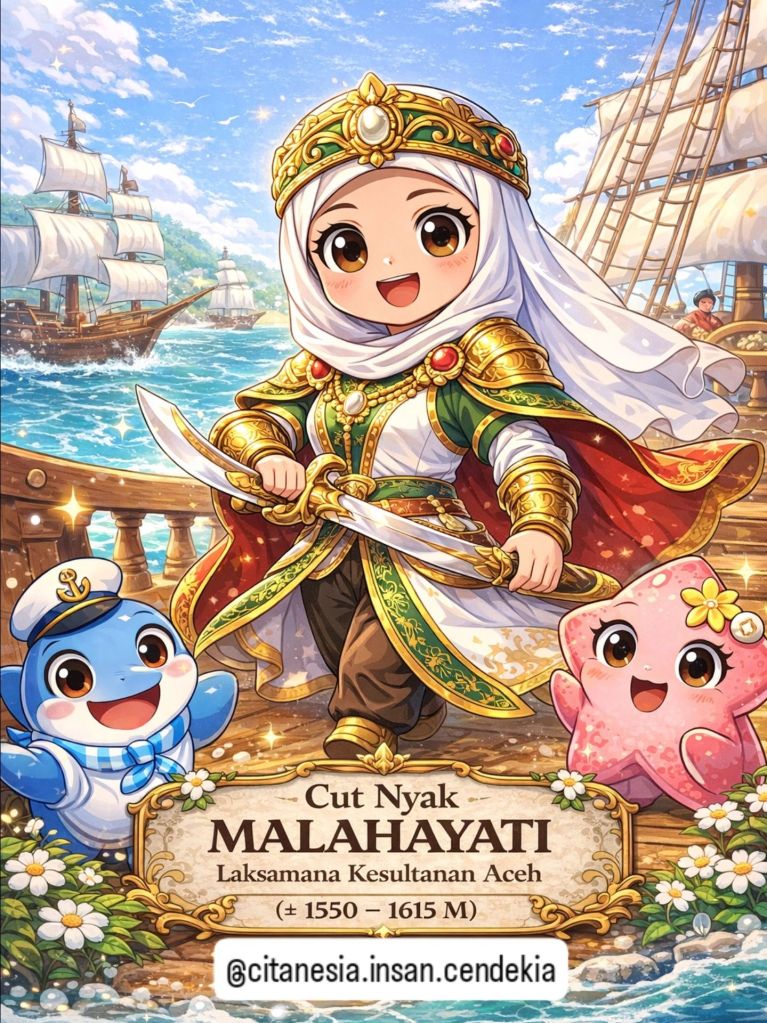
Hello, Friends of Cita & Nesia!
Let us travel to the western edge of the Nusantara.
There, in Aceh, the land meets the wide Indian Ocean.
For hundreds of years, ships travelled through these waters. Traders, sailors, travellers, and powerful kingdoms crossed the sea, making Aceh an important part of the maritime world.
And from this maritime land came one of the most remarkable women in Indonesian history.
Her name was Cut Nyak Keumalahayati, better known as Laksamana Malahayati.
She was a woman who did not simply live beside the sea.
She became a leader upon it.
When the Sea Became a Place of Courage
During Malahayati’s time, in the late sixteenth century, the Sultanate of Aceh was an important maritime power.
Its position near major sea routes brought opportunity.
But it also brought danger.
Foreign ships arrived in the region, and competition over trade and influence could sometimes lead to conflict.
Malahayati lived within this challenging maritime world.
She had also experienced personal loss.
Her husband, who was also a military figure, died in battle.
Imagine how difficult that must have been.
She could have stepped away.
She could have allowed grief to stop her.
But Malahayati chose another path.
She turned loss into courage.
The Women of Inong Balee
Malahayati became associated with a remarkable group known as the Inong Balee.
In Acehnese, inong balee refers to widowed women.
Many of these women had lost their husbands in conflict.
But their stories did not end there.
They came together.
They trained.
They learned to defend their homeland.
And under Malahayati’s leadership, they became part of Aceh’s maritime defence.
The Inong Balee were not simply remembered because they were women.
They were remembered because they demonstrated something powerful:
People who experience loss can still find strength through solidarity.
Instead of facing their grief alone, these women became part of a community with a shared purpose.
Malahayati and the Ships from Far Away
One of the best-known stories about Malahayati concerns the arrival of Dutch ships commanded by Cornelis de Houtman.
In 1599, tensions between the Dutch expedition and Aceh developed into armed conflict.
Malahayati and Acehnese forces confronted them.
Historical accounts associate Malahayati closely with the conflict in which Cornelis de Houtman was killed.
Over generations, the story has often been told as a dramatic encounter in which Malahayati herself defeated him.
Whether every detail of the famous story can be reconstructed with certainty today, its place in Indonesian maritime memory is powerful.
Malahayati became remembered as a woman who stood at the centre of maritime leadership during a difficult period in Aceh’s history.
And that alone makes her extraordinary.
Can a Woman Lead at Sea?
Imagine being a child living hundreds of years ago.
Perhaps you had been told that certain jobs belonged only to men.
Then imagine seeing Malahayati.
A woman giving commands.
A woman organising maritime defence.
A woman leading people.
A woman standing in one of the most demanding spaces of her time.
The sea did not ask whether she was a man or a woman.
Leadership depended on something else:
knowledge, courage, responsibility, and the ability to bring people together.
Malahayati’s story reminds us that maritime history was not created only by kings, male sailors, explorers, and soldiers.
Women were there too.
They led.
They organised.
They protected communities.
And they helped shape the maritime history of the Nusantara.
Strength Does Not Mean Having No Sadness
There is another lesson in Malahayati’s story.
Sometimes we imagine courageous people as people who never feel afraid, sad, or hurt.
But courage does not necessarily mean living without those feelings.
Malahayati experienced loss.
The women of Inong Balee experienced loss too.
Their strength did not come from pretending that nothing painful had happened.
It came from continuing to move forward.
Together.
That is a different kind of strength.
What Does Malahayati Teach Us About Maritime Mindset?
When we hear the words maritime strength, we might immediately imagine:
big ships,
powerful fleets,
weapons,
ports,
or naval forces.
But CitaNesia invites us to look deeper.
Behind every ship are people.
Behind every maritime community are relationships.
And behind strong relationships are values.
Malahayati’s story highlights three of them:
Courage — facing difficult situations even when we are afraid.
Solidarity — standing together rather than facing challenges alone.
Dignity — understanding that people and communities have something worth protecting.
These values can also form part of a maritime mindset.
CitaNesia Insight
Laksamana Malahayati reminds us that a maritime mindset is not only about knowing how to sail or understanding the ocean.
It can also grow from the way people respond to difficult circumstances.
Loss can become solidarity.
Uncertainty can become courage.
And individuals can become leaders when they recognise that others need them.
Malahayati’s maritime world was very different from ours today.
Most of us will never command a fleet.
We may never stand on a ship facing an approaching enemy.
But we will all experience our own waves.
Sometimes the waves are disappointment.
Sometimes they are uncertainty.
Sometimes they are change.
And sometimes they are loss.
The lesson is not that we should become warriors.
The lesson is that a difficult wave does not always have to make us sink.
Sometimes it can teach us how to stand together.
Sometimes it can teach us how to lead.
A Little Question for KawanCita
Imagine that one of your friends is going through a difficult time.
Would being brave mean telling them not to feel sad?
Or could being brave mean staying beside them and helping them move forward?
That is something we can learn from the story of Malahayati and the Inong Balee:
strength can grow when people support one another.
The sea may bring powerful waves.
But people do not always have to face them alone.
— Cita & Nesia
Part of CitaNesia’s Serial Punggawa Laut, sharing stories of people, values, and ideas that have shaped the maritime world of the Nusantara.

