

The Admiral Who Connected Kingdoms Across the Sea
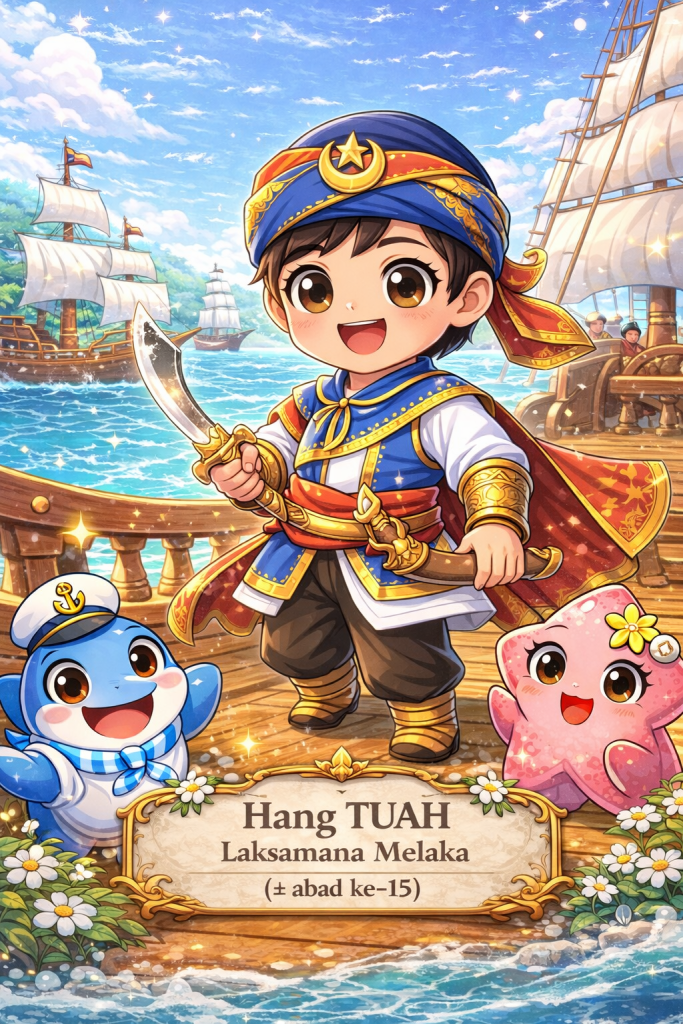
Hello, Friends of Cita & Nesia!
Long ago, around the fifteenth century, there was a powerful maritime kingdom called Melaka.
Its port was busy.
Ships arrived from many places.
Traders brought spices, textiles, ceramics, knowledge, languages, and stories.
The sea around Melaka was not empty space.
It was a great highway connecting people across the region.
And in this busy maritime world lived one of the most legendary figures of the Nusantara.
His name was Hang Tuah.
A Young Man with Courage and Intelligence
Stories about Hang Tuah describe him as brave, clever, disciplined, and deeply loyal.
He was known not only as a skilled fighter, but also as someone trusted by the ruler of Melaka.
As his responsibilities grew, Hang Tuah became associated with the role of laksamana, or admiral.
But being an admiral was not only about fighting battles.
Hang Tuah also travelled as a royal envoy.
That meant he represented Melaka when meeting people from other kingdoms.
Imagine that.
He had to understand how to speak carefully.
He had to know how to behave.
He had to protect the dignity of his kingdom.
And he had to build trust with people from faraway places.
This makes Hang Tuah more than a warrior.
He can also be remembered as a maritime diplomat.
The Sea as a Bridge
When we think about the sea, we sometimes imagine distance.
One island is here.
Another kingdom is far away.
Between them is water.
But for maritime communities, the sea can also do the opposite.
It can bring people together.
Ships carried goods.
Sailors carried knowledge.
Diplomats carried messages.
And travellers carried stories from one society to another.
Hang Tuah lived in this connected world.
His journeys remind us that the sea was not only a place for conflict.
It was also a bridge of civilisation.
Through maritime routes, kingdoms could trade, negotiate, exchange ideas, and learn about one another.
What Makes a Good Maritime Leader?
Imagine that you are asked to represent your community in another country.
What would you need?
Strength?
Perhaps.
But strength alone would not be enough.
You would also need:
Courage — to travel into unfamiliar places.
Wisdom — to know when to speak and when to listen.
Responsibility — because your actions may affect other people.
Trustworthiness — because others need to believe your word.
These qualities help us understand why stories about Hang Tuah have lasted for generations.
He represents an idea of leadership that reaches beyond physical strength.
A maritime leader may need to defend.
But a maritime leader may also need to communicate.
To negotiate.
To understand differences.
And to create relationships.
The Question of Loyalty
One value especially associated with Hang Tuah is loyalty.
Many stories describe his devotion to the Sultan of Melaka and to the kingdom he served.
There is also a famous phrase often associated with his story:
“Takkan Melayu hilang di bumi.”
It is commonly understood as an expression of confidence that Malay identity and culture will endure.
Over generations, Hang Tuah has therefore become more than a historical or literary character.
He has become part of wider conversations about loyalty, identity, leadership, and belonging.
But his story also gives us something interesting to think about.
What does it mean to be loyal?
Does loyalty simply mean following someone?
Or should loyalty also include responsibility, wisdom, and concern for the community?
These are questions that make the story of Hang Tuah continue to be discussed today.
A Maritime World Built Through Relationships
Melaka became important partly because of its position along major maritime trade routes.
But geography alone does not create a successful maritime centre.
People must also be able to cooperate.
Merchants need trust.
Leaders need diplomacy.
Communities need rules.
Visitors need places where they can communicate and exchange goods safely.
Hang Tuah’s story helps us imagine this broader maritime world.
A world in which ships connected ports, but relationships connected people.
CitaNesia Insight
Hang Tuah reminds us that a maritime mindset is not only about protecting the sea.
It is also about understanding connection.
The sea can connect different islands.
It can connect different languages.
It can connect different cultures.
And it can connect different kingdoms.
A strong maritime leader therefore needs more than courage.
They also need the ability to build relationships across differences.
Through the story of Hang Tuah, we can see three important maritime values:
Loyalty — understanding what and whom we are responsible for.
Diplomacy — building relationships through communication rather than conflict alone.
Identity — knowing where we come from while still engaging with a wider world.
Perhaps this is one of the most important lessons from the maritime history of Melaka:
The sea does not only separate people. It can teach people how to meet.
A Little Question for KawanCita
Imagine you meet someone from a place very different from your own.
They speak differently.
They eat different foods.
They have different traditions.
Would those differences stop you from becoming friends?
Or could curiosity help you understand each other?
Hang Tuah’s maritime world reminds us that travelling across the sea often meant encountering people who were different.
Learning how to communicate across those differences was part of maritime life.
And perhaps that is still an important maritime mindset today:
Know who you are, but remain curious about the world beyond your shore.
— Cita & Nesia
Part of CitaNesia’s Serial Punggawa Laut, sharing stories of people, values, and ideas that have shaped the maritime world of the Nusantara.

