
The Sea Between Us, or the Sea That Connects Us?

When looking at a map of Indonesia, it is easy to notice the spaces between the islands.

Blue stretches of water appear to separate Sumatra from Java, Java from Kalimantan, Sulawesi from Maluku, Maluku from Papua, and thousands of smaller islands from one another.

From a land-centred perspective, the sea can look like a gap.

A distance.

Something that must be crossed before reaching somewhere else.

But what if we looked at it differently?

What if, for many communities across the Indonesian archipelago, the sea was never simply the space between places?

What if it was one of the things that connected them?

When Water Was a Pathway
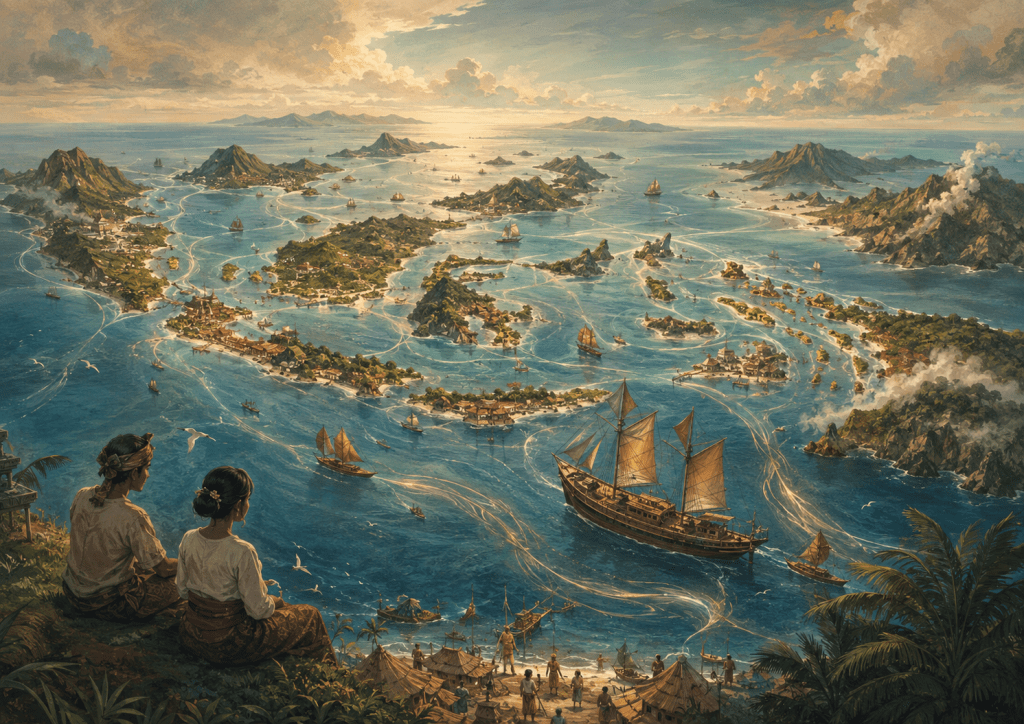
This image is an artistic illustration created for this post. It is not an accurate or official map of Indonesia, but a symbolic representation of the archipelago and the sea as a space of connection.

Long before modern roads, airports and administrative boundaries shaped the way we imagine Indonesia, people travelled through the archipelago by water.

Boats carried people, food, tools, stories, languages, beliefs and knowledge.

Coastal settlements and ports became meeting places. People did not only exchange goods; they encountered different communities and ways of understanding the world.

These maritime connections extended across the archipelago, from the western islands of Sumatra and Java, through Kalimantan, Sulawesi and Maluku, and eastward towards Papua.

In this sense, the sea was not empty space.

It was a pathway.

The movement of people across water created relationships between places that might appear distant when viewed from land.

A community on one island could have social, cultural or economic connections with another community across the sea.

The coastline was not necessarily the end of someone’s world.

Sometimes, it was where another world began.

Islands Do Not Always Mean Isolation

Today, we often describe Indonesia as a country made up of thousands of islands.

The description is geographically correct, but the way we imagine those islands matters.

If we see every island as an individual piece of land surrounded by water, we may unconsciously imagine Indonesia as a collection of separated territories.

But an archipelago can also be understood as a network.

Within that network, the sea is part of the connection.

People navigate through it.

They depend upon it.

They learn its seasons, currents and winds.

They build livelihoods around it.

And through generations of movement, maritime routes can become social and cultural routes as well.

This is also important when thinking about eastern Indonesia. Maluku and Papua should not be imagined simply as distant edges of the map. They are part of wider maritime worlds shaped by movement, exchange, coastal relationships and connections extending across surrounding seas.

Perhaps this is one reason why understanding Indonesia only from the land gives us an incomplete picture.

The Sea Carries More Than Boats

The sea has carried much more than vessels.

It has carried language.

Food.

Music.

Family connections.

Trade.

Migration.

Religious ideas.

Technology.

Stories.

And memories.

Across generations, these movements contributed to the extraordinary diversity that exists throughout Nusantara, including the many distinctive coastal and island communities of eastern Indonesia and Papua.

Different places maintained their own identities, yet they were rarely completely disconnected from the worlds around them.

The sea allowed encounters to happen.

Sometimes peacefully.

Sometimes competitively.

Sometimes through migration, trade, political expansion or conflict.

Maritime connection does not mean that the history of the archipelago was always harmonious.

But it reminds us that water has continually participated in shaping relationships between people and places.

Changing the Way We Look at the Map

Perhaps we can try a small exercise.

Look at a map of Indonesia again.

This time, instead of looking first at the islands, look at the blue.

Look at the Malacca Strait.

The Java Sea.

The Makassar Strait.

The Flores Sea.

The Banda Sea.

The Arafura Sea.

The waters surrounding Maluku and Papua.

And the many other seas and straits that weave around and between the islands.

Suddenly, the map can tell a slightly different story.

The water does not disappear.

It becomes part of the geography we pay attention to.

And when we begin recognising the sea as a space of movement, memory and interaction, Indonesia starts to look less like scattered pieces of land and more like an interconnected maritime world stretching from Sumatra to Papua.

What Does This Mean for Maritime Identity?

Being an archipelagic country does not automatically mean that everyone identifies with the sea.

Many Indonesians grow up far from the coast. Their everyday lives may be shaped more strongly by farms, mountains, cities, rivers or forests.

This is particularly important in a country as geographically and culturally diverse as Indonesia, where communities in places such as the highlands of Papua may have relationships with landscape that are very different from those of coastal communities.

Maritime identity therefore does not need to mean that every Indonesian must think like a sailor.

Perhaps it can mean something broader.

It can begin with recognising that the sea has played an important role in shaping the relationships between our islands, communities and histories.

The sea can be understood not only as a resource to use or a boundary to defend, but also as part of the cultural and geographical fabric that has connected people across Nusantara.

And perhaps that changes one simple question.

Instead of asking:

What separates one Indonesian island from another?

We might also ask:

What has connected them?

Sometimes, the answer has always been there—

flowing quietly between the shores.

The sea.

Maritime Identity Development in Indonesia

Research, reflection and a continuing conversation about Indonesia’s maritime future

Indonesia has always been maritime.

Long before the language of contemporary maritime policy emerged, communities across the archipelago had lived with, travelled across, worked upon, learned from and built relationships around the sea.

Indonesia’s maritime identity did not begin with a policy, an institution, or academic research.

It has existed across generations—in histories and cultures, coastal communities and livelihoods, navigation and trade, knowledge and traditions, ports and fisheries, islands and the countless relationships connecting people with the waters between them.

My academic journey led me to explore one particular question within this much larger story: how might Maritime Identity Development—or MID—help us understand the relationship between people, identity and Indonesia’s maritime future?

The formal research journey has been completed.

But my curiosity has not.

This page is a space for that journey to continue.

From academic research to public conversation

Academic research is usually communicated through dissertations, journal articles, conferences and other scholarly publications. Those forms matter, and research intended for scholarly publication belongs within the appropriate academic processes.

This space has a different purpose.

Here, I hope to gradually communicate some of the ideas, questions and reflections that emerged through my academic journey in language that can travel beyond academic writing.

It is not intended to reproduce my dissertation or replace scholarly publications.

Instead, it is a personal space for research communication, reflection and continuing learning—a place where I can explain ideas in more accessible ways, revisit questions that stayed with me, connect them with new conversations, and continue thinking about Indonesia’s relationship with the maritime world.

I also hope it can become a place for conversation.

MID emerged through academic research, but questions about Indonesia’s relationship with the sea belong to a much wider community than academia alone.

Maritime Identity Development

Maritime Identity Development (MID) became the central idea through which I explored relationships between people, identity and the maritime domain.

At its heart is a relatively simple question:

What does it mean for people to understand themselves as part of a maritime nation?

Being an archipelagic country does not, by itself, tell us how people understand their relationship with the maritime world.

Geography matters, but so do people.

Relationships with the sea can be influenced by culture, education, knowledge, institutions, policies, histories, experiences, communities and the stories through which a society understands itself.

Thinking about maritime development therefore invites questions beyond ships, ports, fisheries, infrastructure, maritime security or economic resources.

It also invites us to ask:

Where is the ocean in the way we understand ourselves?

Not creating an identity, but caring for what already exists

There is an important distinction I want to make.

Maritime Identity Development does not mean that Indonesia needs someone to create a maritime identity for it.

Indonesia already possesses diverse and deeply rooted maritime identities.

They have been carried through generations by traditional and Indigenous maritime communities, fishers, seafarers, coastal communities and many others whose cultures, knowledge, livelihoods and everyday lives are intertwined with the sea.

They are also part of the wider inheritance of Indonesian people as citizens of an archipelagic nation.

No single framework, researcher or institution could encompass that diversity.

My interest in Maritime Identity Development is therefore not about replacing what already exists or determining what Indonesian maritime identity should be.

Instead, it invites me to continue asking how these relationships might be recognised, understood, cared for and strengthened as Indonesia continues towards its maritime future.

Perhaps the more important questions are:

What maritime identities have we inherited? What do they mean to us today? And what do we want to carry forward for future generations?

Why this journey continues

Completing an academic research journey does not necessarily mean reaching the end of its questions.

For me, it created new ones.

Some may belong within future academic research. Others are reflections that I would simply like to communicate more widely. Still others may emerge from reading, conversations, communities, policy developments or changes within Indonesia’s maritime world.

CitaNesia gives those thoughts somewhere to continue.

It allows me to translate academic thinking into more accessible conversations, continue learning beyond the formal research process, and hopefully contribute—however modestly—to keeping people and maritime identity within conversations about Indonesia’s future.

This is not a repository for my academic publications.

It is a space where some of the thinking surrounding that academic journey can continue to breathe.

A personal expression of gratitude

There is another reason this page exists.

Gratitude.

Research is never produced by a researcher alone.

Behind an academic journey are people who teach, question, participate, share knowledge, provide opportunities, challenge assumptions and support the long process through which ideas develop.

My journey with Maritime Identity Development was shaped by many such contributions.

To the people who supported this journey, shared their knowledge and perspectives, participated in conversations, challenged my thinking, or contributed in ways both visible and invisible:

Terima kasih.

And more broadly, this space is dedicated with gratitude to Indonesia and its people.

Indonesia provided much more than the geographical context for my research. Its people, histories, maritime cultures, challenges, aspirations and relationship with the sea provided the questions that allowed this intellectual journey to grow.

I hope that, in a small way, some of the knowledge and thinking developed through that journey can return to the wider community.

Not as an answer belonging to one researcher.

Not as a prescription for what Indonesia should become.

But as a contribution to a much larger conversation that belongs to all of us.

Looking towards Indonesia’s maritime future

I do not see Maritime Identity Development as a finished conversation.

Indonesia will continue to change.

Its relationship with the ocean will continue to evolve alongside environmental change, technology, economic development, education, policy, culture and the aspirations of new generations.

The questions must therefore continue too.

I hope this space can gradually become somewhere that research meets public curiosity, established knowledge encounters new questions, and people interested in Indonesia’s maritime identity—researchers, students, practitioners, communities, educators or simply curious readers—can encounter ideas and perhaps contribute their own perspectives.

Because ultimately:

Indonesia’s maritime identity is not something for one person to define. It is a living inheritance carried by its people—by those who have carried it through generations, those who live and care for it today, and those who will carry it into the future.

For me, continuing to think, communicate and care about that future is one way of saying:

Terima kasih, Indonesia.