Before We Knew the Word โ€œMaritimeโ€, We Sang About the Sea

Nenek Moyangku Orang Pelaut and the Quiet Inheritance of Indonesiaโ€™s Maritime Imagination

Long before many of us understood words such as maritime, archipelago, ocean governance, or maritime identity, we may already have encountered the sea through something much simpler:

a childrenโ€™s song.

For generations of Indonesians, Nenek Moyangku Orang Pelaut has been one of those familiar songs carried from childhood.

Written by Ibu Soed, or Saridjah Niung, the song has become closely associated with the image of Indonesia as a maritime nation and with memories of earlier generations whose lives were connected with the sea.

But perhaps what makes the song especially interesting today is not only what it tells us about the past.

It is what it may quietly have taught us about the sea.

Before Maritime Became a Concept

Children do not normally begin by learning definitions of maritime culture or maritime identity.

They encounter the world differently.

Through stories.

Through family memories.

Through places.

Through language.

And sometimes through songs.

Nenek Moyangku Orang Pelaut introduces the sea not through geography or policy, but through ancestry.

The opening idea is simple yet powerful: our ancestors were seafarers.

In that sentence, the sea is already more than water surrounding the islands.

It becomes connected with memory, movement and belonging.

Perhaps, before we could explain what it meant to be part of an archipelagic nation, we had already begun imagining ourselves in relation to the sea.

The Sea Is Not Merely a Background

Another interesting aspect of the song is the kind of sea that it imagines.

It is not a motionless blue landscape.

It is a space of waves, wind, storms, sails and journeys.

The maritime world presented to children is therefore one of movement and uncertainty.

To go to sea requires interaction with forces that cannot simply be controlled.

There must be courage, adaptation, knowledge and an ability to continue moving through changing conditions.

Seen from this perspective, the song can be read not simply as a celebration of seafaring, but as an early cultural image of a maritime mindset.

A maritime mindset does not necessarily mean that everyone must become a sailor.

Rather, it may involve ways of thinking shaped by movement, connection, uncertainty, resilience and an awareness that the sea is an active part of our lives.

A Quiet Cultural Inheritance

The words nenek moyangku are also important.

They connect the present with earlier generations.

This does not mean that every Indonesian shares the same maritime history or that maritime identity should be understood as something automatically inherited.

Indonesia is extraordinarily diverse.

Relationships with the sea differ across islands, communities, cultures and generations.

For some communities, the sea remains part of everyday life.

For others, particularly those living far from the coast, the relationship may be more distant.

Yet songs, stories and collective memories can allow ideas about the sea to travel far beyond coastal communities.

In this sense, maritime imagination can become a form of cultural inheritance.

Something can remain within collective memory even when our daily lives have moved far away from the circumstances that originally shaped it.

From Ancestors to the Present Generation

This is where the song becomes especially interesting for CitaNesia.

Singing that our ancestors were seafarers is one thing.

Asking what that inheritance means today is another.

Indonesia has changed dramatically.

Most Indonesians will never spend their lives navigating the open sea.

Technology has transformed transportation, communication and maritime activity.

Yet the sea continues to shape the country.

It connects islands.

It supports livelihoods.

It carries trade.

It contains ecosystems of extraordinary importance.

It influences culture, security, food systems, energy, climate and Indonesiaโ€™s relationships with the wider world.

Perhaps, then, carrying a maritime inheritance today does not simply mean remembering that earlier generations sailed.

It may also mean developing a contemporary relationship with the sea.

That could involve understanding marine environments.

Respecting coastal and maritime communities.

Protecting ecosystems.

Learning about Indonesiaโ€™s maritime history.

Recognising the importance of sea connectivity.

Developing maritime knowledge.

Or simply remembering that the waters between Indonesiaโ€™s islands are not empty spaces separating the nation.

They are among the spaces that connect it.

When a Childhood Song Becomes a Question

Perhaps many of us sang Nenek Moyangku Orang Pelaut without thinking very deeply about its meaning.

That is perfectly natural.

We were children.

But returning to the song later in life allows a different question to emerge.

What kind of relationship with the sea did those simple words quietly introduce to us?

Perhaps maritime consciousness does not always begin in universities, government policies or strategic documents.

Sometimes it begins much earlier.

In a classroom.

In a family story.

In the memory of a harbour.

In the vocabulary of a community.

Or in a song that children sing before they even know what the word maritime means.

And perhaps the question for our generation is no longer simply:

Were our ancestors seafarers?

The more important question may be:

What kind of maritime generation do we choose to become?


CitaNesia Reflection

CitaNesia explores maritime mindset not as a requirement that every Indonesian must think about the sea in the same way, but as something that can grow through knowledge, experience, culture and reflection.

Nenek Moyangku Orang Pelaut offers a small but fascinating example.

A children’s song may seem simple.

Yet within it can travel memories of ancestors, ideas about courage and movement, and an imagination of Indonesia in which the sea has never been entirely separate from who we are.

Perhaps that is one of the quiet ways a maritime mindset begins.
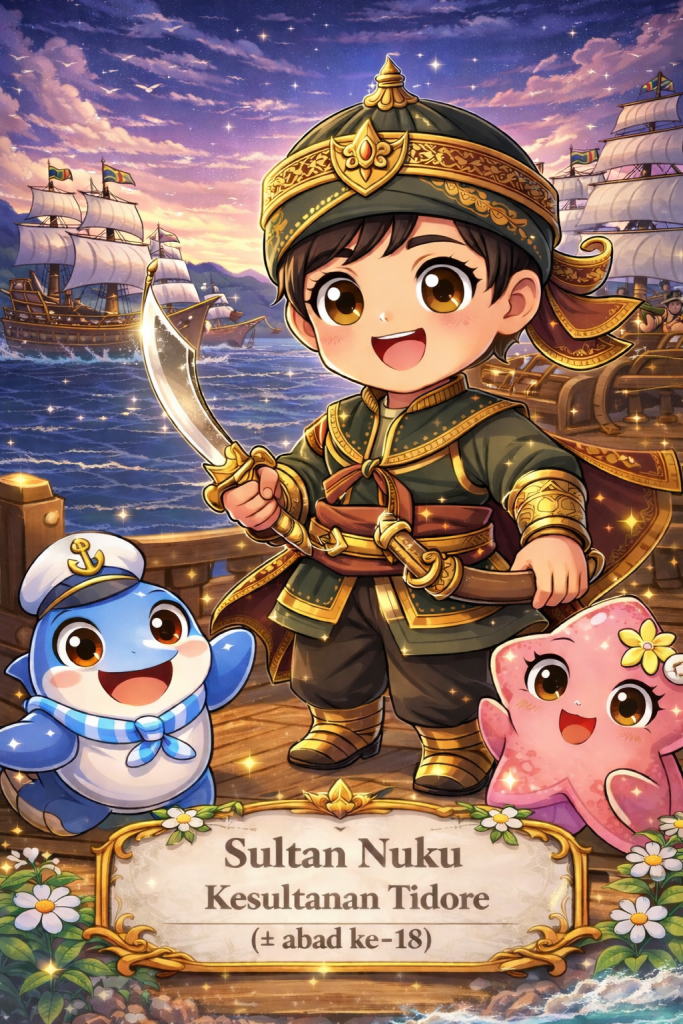
Serial Punggawa Laut Episode 5: Sultan Nuku: Penggerak Armada Persatuan dari Timur Nusantara

The Sultan Who Built Alliances Across the Eastern Seas

This image is a creative illustration for storytelling and educational purposes.

Hello, Friends of Cita & Nesia!

This time, let us travel once again to the beautiful islands of Maluku.

But we are travelling to a different time and meeting a different maritime leader.

Our destination is Tidore.

And our story takes us to the late eighteenth century, more than two hundred years after the time of Sultan Baabullah.

There, among islands surrounded by busy seas, lived a prince who would spend many years resisting foreign control and bringing communities together across a vast maritime world.

His name was Nuku.

He would later become known as Sultan Nuku of Tidore.

A Prince Who Refused to Give Up

Nuku was born into the royal family of Tidore.

His father was Sultan Jamaluddin.

But this was a difficult period for the Sultanate.

European colonial powers had become deeply involved in the politics and spice trade of Maluku, and Dutch influence increasingly affected the affairs of Tidore.

Nuku refused to simply accept this situation.

Around 1780, he emerged as an important leader of resistance.

But there was one big problem.

Nuku did not initially control Tidore itself.

So how could a prince without a secure capital continue a struggle against a powerful colonial company?

This is where his story becomes especially interesting.

He built connections.

The Sea Became His Network

Look at a map of eastern Indonesia.

You will see islands everywhere.

Tidore.

Halmahera.

Seram.

Raja Ampat.

And farther east, Papua.

To someone who thinks only about land, these places may appear separated.

There is water between them.

But Nuku understood the maritime world differently.

The sea could connect them.

He travelled through these maritime networks and gathered supporters from different communities.

Historical accounts describe support connected with Raja Ampat, eastern Seram, parts of Halmahera, and Papua.

His struggle therefore did not depend on only one island.

It grew through relationships across many islands.

Boats carried people.

Boats carried messages.

Boats carried supplies.

And, perhaps most importantly, the sea allowed alliances to grow.

Imagine Leading Without a Telephone

KawanCita, imagine something for a moment.

You want to bring people together across many islands.

But there is:

No telephone.

No internet.

No aeroplane.

No instant messaging.

You cannot simply create a group chat and write:

โ€œEveryone, meeting tomorrow at 9!โ€

You have to sail.

Messages may take days or longer to arrive.

Weather can change.

The sea can become rough.

And communities may have different interests and leaders.

Yet Nuku managed to maintain relationships across this enormous maritime space for many years.

That required more than bravery.

It required communication, trust, patience and strategy.

Friends in Different Places

Nuku also understood something that good leaders often understand:

Sometimes we need allies.

His supporters did not all come from exactly the same place or background.

Different communities joined his wider struggle at different times.

Nuku also developed relationships with English traders and later benefited from British support as he challenged Dutch power in the region.

This makes his story particularly interesting.

He was not simply fighting battles.

He was navigating a complicated world of:

local communities,

island rulers,

trading networks,

European powers,

and changing alliances.

A good maritime leader had to understand all of them.

Returning to Tidore

Nuku’s struggle lasted for many years.

There were successes.

There were setbacks.

There were moments when his position became weaker.

But he continued.

Eventually, his alliances and persistence helped him regain Tidore.

By 1797, Nuku had established himself as Sultan of Tidore.

After so many years of struggle, he had returned not simply as a prince seeking a throne, but as a leader supported by a broad maritime network.

He continued ruling until his death in 1805.

Today, Sultan Nuku is remembered as one of Indonesia’s National Heroes.

A Kingdom Larger Than One Island

Here is something very important about the story of Tidore.

When we hear โ€œSultanate of Tidoreโ€, we might imagine only the small island of Tidore.

But historically, Tidore’s relationships extended much farther.

Its political and cultural connections reached parts of Halmahera, Seram, Raja Ampat and Papua.

This helps us understand something important about maritime history.

A maritime kingdom does not always look like a large block of land on a map.

Its world can be made of routes and relationships.

One island connects with another.

One community communicates with another.

One harbour opens a pathway towards another sea.

The water between them is not necessarily an empty space.

The water is part of the network.

What Made Sultan Nuku Strong?

Was it simply because he had ships?

No.

Was it simply because he could fight?

No.

Nuku’s strength also came from his ability to maintain relationships.

His story highlights several qualities:

Persistence โ€” he continued his struggle for many years despite setbacks.

Strategy โ€” he understood that different situations required different approaches.

Alliance-building โ€” he brought together communities across a wide maritime area.

Adaptability โ€” he worked within a complicated world of changing political relationships.

Maritime knowledge โ€” he understood that islands and seas formed an interconnected political landscape.

These are very different forms of strength.

CitaNesia Insight

Sultan Nuku’s story teaches us something especially important about a maritime mindset:

You do not always become stronger by standing alone.

Sometimes strength comes from knowing how to connect.

An island may be small.

But connect it with another island, and the network becomes larger.

Connect communities.

Share knowledge.

Build trust.

Maintain relationships.

Suddenly, distance does not necessarily mean isolation.

This was one of the remarkable features of Nuku’s maritime world.

The seas of eastern Nusantara did not merely surround his struggle.

They made his network possible.

His story therefore gives us four important maritime values:

Persistence โ€” keep moving even when the journey becomes difficult.

Connection โ€” recognise that relationships can cross seas and distances.

Strategy โ€” think carefully rather than relying only on strength.

Unity in diversity โ€” people from different communities can work together when they find a shared purpose.

A Little Question for KawanCita

Imagine you have a very difficult problem.

Would you rather solve everything completely alone?

Or could you ask:

โ€œWho might know something that I don’t?โ€

โ€œWho could help?โ€

โ€œAnd what could I contribute in return?โ€

Asking for help does not necessarily make us weaker.

Sometimes knowing how to build a good team is itself a form of leadership.

That may be one of the most interesting lessons we can learn from Sultan Nuku.

He lived in a world of many islands.

Many communities.

Many interests.

And many challenges.

Yet he understood that the spaces between islands did not have to keep people apart.

The sea could become the pathway that brought them together.

โ€” Cita & Nesia

Part of CitaNesia’s Serial Punggawa Laut, sharing stories of people, values, and ideas that have shaped the maritime world of the Nusantara.

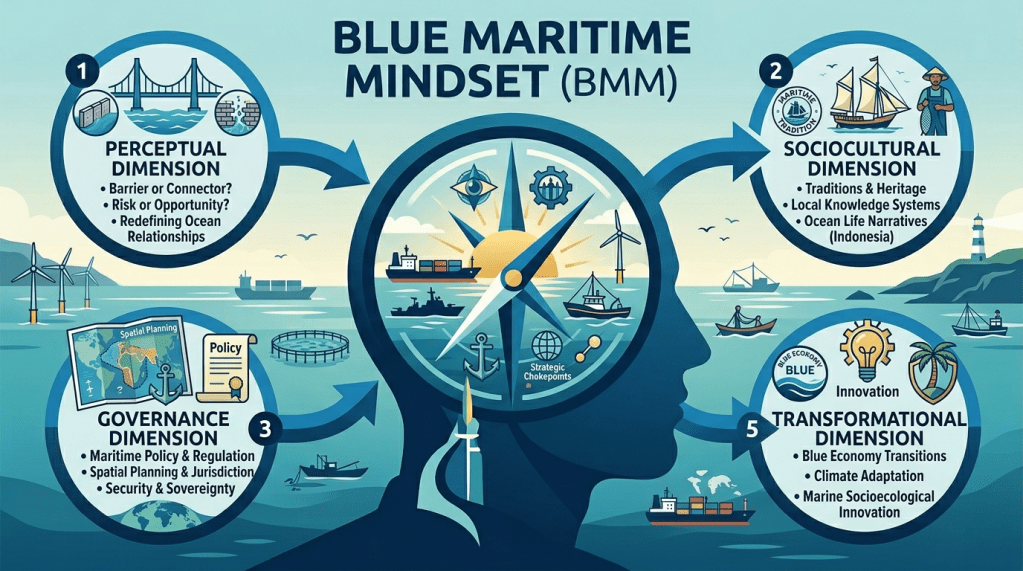
Blue Maritime Mindset (BMM): A Conceptual Foundation within GlossaryNesia

Blue Maritime Mindset (BMM)
A Conceptual Foundation within GlossaryNesia


Introduction


Within GlossaryNesia, the Blue Maritime Mindset (BMM) is introduced as a foundational concept to reframe how we understand the sea. Rather than viewing the ocean as a passive geographical space, BMM positions it as an active system of connection, identity, and strategic influence.
This mindset is particularly relevant in the context of Indonesia, where the sea is not a boundary between islands, but the very element that binds the nation together.


What is Blue Maritime Mindset?


Blue Maritime Mindset (BMM) is a cognitive and sociocultural framework that shapes how individuals, communities, and institutions perceive and engage with the maritime domain.
It expands conventional maritime perspectives by integrating:
Cognitive awareness of the sea as a living system
Cultural meaning embedded in maritime identity
Governance structures that organise ocean space
Strategic understanding of maritime connectivity and flows
In this framework, the sea becomes a dynamic mediumโ€”not only for transportation or resources, but also for energy, influence, and continuity.


How is BMM Constructed?


The construction of the Blue Maritime Mindset is layered and integrative. It emerges through the interaction of five key dimensions:


1. Perceptual Dimension
This dimension concerns how the sea is understood at the level of mindset:
Is it seen as a barrier or a connector?
As a risk or an opportunity?
Shifts at this level redefine how societies relate to maritime space.


2. Sociocultural Dimension
This dimension reflects how the sea is embedded in identity:
Maritime traditions and heritage
Local knowledge systems
Narratives and symbols of ocean life
For Indonesia, this dimension is central to reinforcing its archipelagic identity.


3. Governance Dimension
This dimension translates mindset into institutional practice:
Maritime policy and regulation
Spatial planning and jurisdiction
Security and sovereignty frameworks
It determines how maritime space is managed and protected.


4. Connectivity Dimension
This dimension highlights the sea as a system of flows:
Trade and logistics routes
Energy distribution pathways
Global interdependence through maritime networks
Strategic chokepoints, such as international straits, illustrate how the sea operates as a global circulatory system.


5. Transformational Dimension
This dimension looks toward the future:
Blue economy transitions
Climate adaptation and resilience
Innovation in marine socioecological systems
It positions BMM as a mindset for navigating uncertainty and change.


Why BMM Matters


The Blue Maritime Mindset provides a strategic lens to:
Reposition the sea as the centre of national identity and development
Strengthen maritime governance and policy coherence
Integrate local wisdom with global maritime systems
Recognise the ocean as a medium of energy, connectivity, and resilience
For Indonesia, adopting BMM is not optionalโ€”it is essential for unlocking its full maritime potential.


Closing Reflection


Within GlossaryNesia, BMM serves as a conceptual anchor. It bridges knowledge, identity, and practiceโ€”allowing maritime thinking to evolve beyond fragmented perspectives into a more integrated and meaningful understanding of the ocean.

โœ๐Ÿฝ: Founder of Citanesia

๐Ÿ“ง : citanesia.insan.cendekia@gmail.com

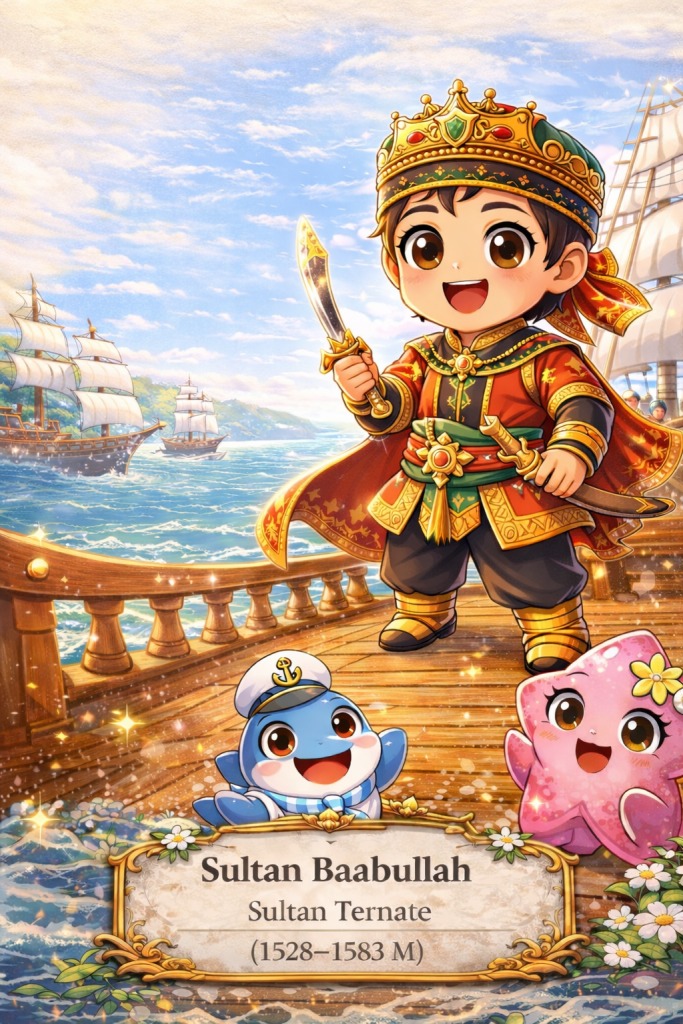
Serial Punggawa Laut Episode 4: Sultan Baabullah Penguasa Laut dari Ternate

The Sultan Who Defended the Spice Islands

This image is a creative illustration for storytelling and educational purposes.

Hello, Friends of Cita & Nesia!

This time, let us travel to the eastern part of the Nusantara.

Far across the sea, among the beautiful islands of Maluku, there was once a powerful maritime kingdom called Ternate.

The islands were small.

But their importance was enormous.

Why?

Because they were home to something the world greatly desired:

spices.

Cloves from Maluku travelled across the seas and reached distant lands.

Ships came from many places.

Traders arrived.

Foreign powers also came.

And in the middle of this busy maritime world stood a remarkable leader.

His name was Sultan Baabullah.

The Sultan of Ternate

Sultan Baabullah ruled Ternate during the sixteenth century.

He was known as a determined leader who understood that protecting his kingdom meant protecting not only the land, but also the surrounding seas.

For island communities, the sea was everything.

It was a road.

A source of food.

A trading route.

A connection between islands.

And sometimes, it was also a place that needed to be defended.

During Sultan Baabullahโ€™s time, the Maluku Islands had become one of the most important centres of the global spice trade.

That brought prosperity.

But it also brought competition.

Foreign powers wanted access to the valuable spices and control over important maritime routes.

For Ternate, this created a difficult challenge.

When Foreign Powers Came

Among the foreign powers present in the region were the Portuguese.

Relations between Ternate and the Portuguese changed over time and eventually became deeply hostile.

Sultan Baabullah inherited a period of serious conflict.

Instead of giving up, he organised resistance.

But he did not act alone.

His strength depended on people.

Communities.

Allies.

And networks across the islands.

That is important.

Because defending a maritime kingdom spread across many islands could never be the work of one person.

It required unity.

A Struggle Across the Sea

Imagine trying to protect a kingdom made up of islands.

There are no highways connecting them.

No trains.

No cars travelling from one island to another.

The sea is the highway.

Messages travel by boat.

People travel by boat.

Food travels by boat.

And warriors travel by boat.

This meant that maritime knowledge was essential.

Leaders needed to understand routes, islands, alliances, and the movement of people across the sea.

Sultan Baabullah used these connections as part of a long campaign against the Portuguese presence in Ternate.

After years of conflict, the Portuguese were forced to leave their fort in Ternate in 1575.

For Ternate, this was a major victory.

Why Was Baabullah Called the Ruler of 72 Islands?

Sultan Baabullah later became associated with the title โ€œRuler of 72 Islands.โ€

What does that mean?

It does not necessarily mean that he personally stood on every island giving orders.

It reflects the wide network of influence connected to Ternate during his reign.

Across eastern Nusantara, political relationships were often built through islands, trading routes, alliances, tribute, family relationships, and maritime connections.

The sea helped hold these networks together.

This gives us an important lesson.

A maritime kingdom is not always shaped like a land kingdom.

Its strength can come from connections across water.

One island may be separated from another geographically, but maritime relationships can bring them together politically, economically, and socially.

The Spice Islands and the Wider World

There is something else fascinating about Sultan Baabullahโ€™s story.

The history of Ternate was not happening only in one small corner of the world.

Maluku was connected to something much larger.

Spices from these islands travelled enormous distances.

They became part of trade networks linking Southeast Asia with other regions.

This means that communities living in relatively small islands could have enormous importance in global history.

Isnโ€™t that amazing?

Sometimes we look at a map and think that a small island must also have a small story.

But maritime history teaches us otherwise.

A small island can sit at the centre of a very large network.

What Makes a Maritime Leader Strong?

Sultan Baabullahโ€™s story is often remembered because of resistance and military victory.

But CitaNesia invites us to look a little deeper.

How could a leader maintain influence across many islands?

Physical strength alone would not be enough.

A maritime leader also needed:

Strategy โ€” understanding when and how to act.

Unity โ€” bringing different communities together.

Knowledge โ€” understanding people, places, routes, and relationships.

Determination โ€” continuing even when a struggle became difficult.

These qualities helped turn separate communities into a stronger network.

CitaNesia Insight

Sultan Baabullah reminds us that a maritime mindset can also be about understanding interdependence.

One island cannot always stand alone.

Communities depend on other communities.

Ports depend on maritime routes.

Trade depends on relationships.

And leaders depend on the trust and support of people.

Sultan Baabullahโ€™s story therefore offers us several important maritime values:

Courage โ€” standing firm when something important must be protected.

Unity โ€” recognising that collective strength can be greater than individual strength.

Strategy โ€” thinking carefully before acting.

Connection โ€” understanding that islands become stronger when relationships across the sea remain strong.

His story also reminds us of something important about Indonesia.

The sea does not make islands isolated.

The sea can make islands part of a network.

A Little Question for KawanCita

Imagine you are given one stick.

It might break easily.

Now imagine many sticks tied together.

Would they be harder to break?

Communities can be like that too.

When people stand alone, challenges can feel very large.

But when people cooperate, share knowledge, and help one another, they can become much stronger.

That is one lesson we can take from Sultan Baabullah and the maritime world of Ternate:

Strength does not always come from being the biggest. Sometimes it comes from being connected.

And perhaps that is one of the greatest lessons the islands of the Nusantara can teach us.

โ€” Cita & Nesia

Part of CitaNesiaโ€™s Serial Punggawa Laut, sharing stories of people, values, and ideas that have shaped the maritime world of the Nusantara.

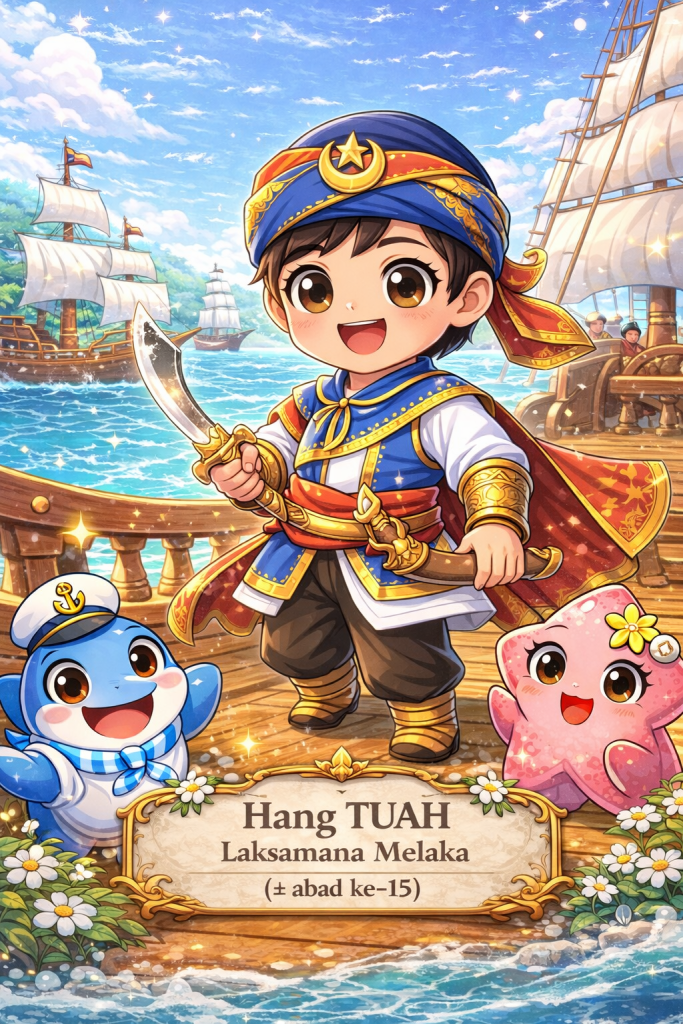
Serial Punggawa Laut Episode 3: Hang Tuah

The Admiral Who Connected Kingdoms Across the Sea

This image is a creative illustration for storytelling and educational purposes.

Hello, Friends of Cita & Nesia!

Long ago, around the fifteenth century, there was a powerful maritime kingdom called Melaka.

Its port was busy.

Ships arrived from many places.

Traders brought spices, textiles, ceramics, knowledge, languages, and stories.

The sea around Melaka was not empty space.

It was a great highway connecting people across the region.

And in this busy maritime world lived one of the most legendary figures of the Nusantara.

His name was Hang Tuah.

A Young Man with Courage and Intelligence

Stories about Hang Tuah describe him as brave, clever, disciplined, and deeply loyal.

He was known not only as a skilled fighter, but also as someone trusted by the ruler of Melaka.

As his responsibilities grew, Hang Tuah became associated with the role of laksamana, or admiral.

But being an admiral was not only about fighting battles.

Hang Tuah also travelled as a royal envoy.

That meant he represented Melaka when meeting people from other kingdoms.

Imagine that.

He had to understand how to speak carefully.

He had to know how to behave.

He had to protect the dignity of his kingdom.

And he had to build trust with people from faraway places.

This makes Hang Tuah more than a warrior.

He can also be remembered as a maritime diplomat.

The Sea as a Bridge

When we think about the sea, we sometimes imagine distance.

One island is here.

Another kingdom is far away.

Between them is water.

But for maritime communities, the sea can also do the opposite.

It can bring people together.

Ships carried goods.

Sailors carried knowledge.

Diplomats carried messages.

And travellers carried stories from one society to another.

Hang Tuah lived in this connected world.

His journeys remind us that the sea was not only a place for conflict.

It was also a bridge of civilisation.

Through maritime routes, kingdoms could trade, negotiate, exchange ideas, and learn about one another.

What Makes a Good Maritime Leader?

Imagine that you are asked to represent your community in another country.

What would you need?

Strength?

Perhaps.

But strength alone would not be enough.

You would also need:

Courage โ€” to travel into unfamiliar places.

Wisdom โ€” to know when to speak and when to listen.

Responsibility โ€” because your actions may affect other people.

Trustworthiness โ€” because others need to believe your word.

These qualities help us understand why stories about Hang Tuah have lasted for generations.

He represents an idea of leadership that reaches beyond physical strength.

A maritime leader may need to defend.

But a maritime leader may also need to communicate.

To negotiate.

To understand differences.

And to create relationships.

The Question of Loyalty

One value especially associated with Hang Tuah is loyalty.

Many stories describe his devotion to the Sultan of Melaka and to the kingdom he served.

There is also a famous phrase often associated with his story:

โ€œTakkan Melayu hilang di bumi.โ€

It is commonly understood as an expression of confidence that Malay identity and culture will endure.

Over generations, Hang Tuah has therefore become more than a historical or literary character.

He has become part of wider conversations about loyalty, identity, leadership, and belonging.

But his story also gives us something interesting to think about.

What does it mean to be loyal?

Does loyalty simply mean following someone?

Or should loyalty also include responsibility, wisdom, and concern for the community?

These are questions that make the story of Hang Tuah continue to be discussed today.

A Maritime World Built Through Relationships

Melaka became important partly because of its position along major maritime trade routes.

But geography alone does not create a successful maritime centre.

People must also be able to cooperate.

Merchants need trust.

Leaders need diplomacy.

Communities need rules.

Visitors need places where they can communicate and exchange goods safely.

Hang Tuah’s story helps us imagine this broader maritime world.

A world in which ships connected ports, but relationships connected people.

CitaNesia Insight

Hang Tuah reminds us that a maritime mindset is not only about protecting the sea.

It is also about understanding connection.

The sea can connect different islands.

It can connect different languages.

It can connect different cultures.

And it can connect different kingdoms.

A strong maritime leader therefore needs more than courage.

They also need the ability to build relationships across differences.

Through the story of Hang Tuah, we can see three important maritime values:

Loyalty โ€” understanding what and whom we are responsible for.

Diplomacy โ€” building relationships through communication rather than conflict alone.

Identity โ€” knowing where we come from while still engaging with a wider world.

Perhaps this is one of the most important lessons from the maritime history of Melaka:

The sea does not only separate people. It can teach people how to meet.

A Little Question for KawanCita

Imagine you meet someone from a place very different from your own.

They speak differently.

They eat different foods.

They have different traditions.

Would those differences stop you from becoming friends?

Or could curiosity help you understand each other?

Hang Tuah’s maritime world reminds us that travelling across the sea often meant encountering people who were different.

Learning how to communicate across those differences was part of maritime life.

And perhaps that is still an important maritime mindset today:

Know who you are, but remain curious about the world beyond your shore.

โ€” Cita & Nesia

Part of CitaNesia’s Serial Punggawa Laut, sharing stories of people, values, and ideas that have shaped the maritime world of the Nusantara.

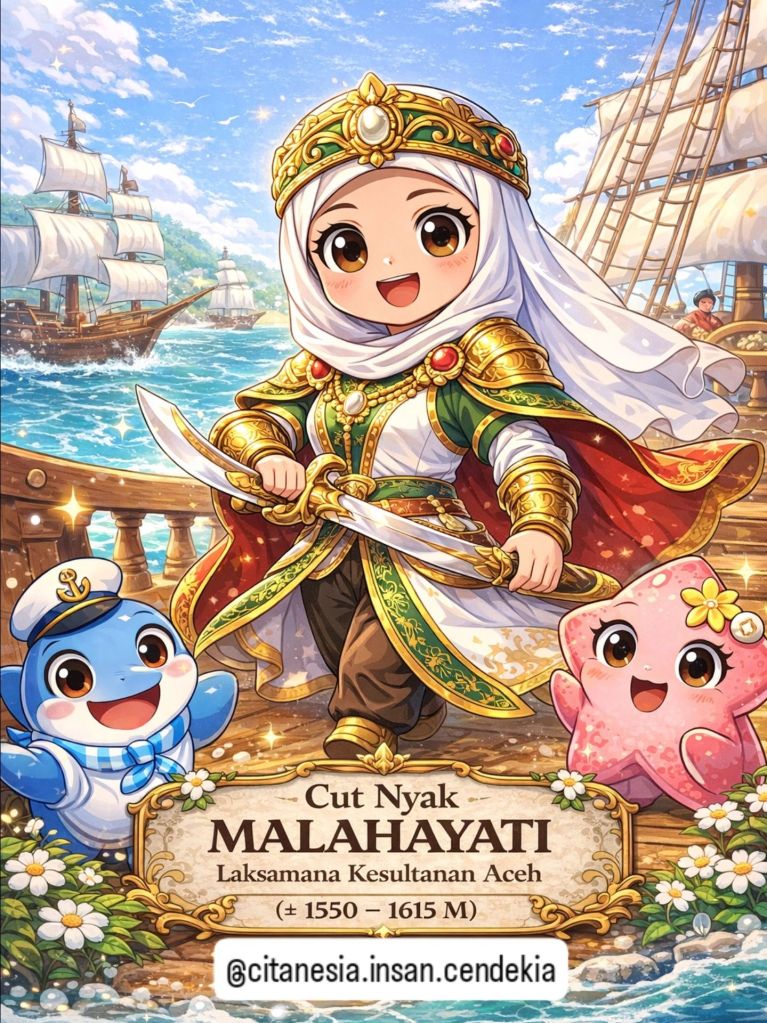
Serial Punggawa Laut Episode 2: Cut Nyak Malahayati

The Admiral Who Turned Courage into Strength

This image is a creative illustration for storytelling and educational purposes

Hello, Friends of Cita & Nesia!

Let us travel to the western edge of the Nusantara.

There, in Aceh, the land meets the wide Indian Ocean.

For hundreds of years, ships travelled through these waters. Traders, sailors, travellers, and powerful kingdoms crossed the sea, making Aceh an important part of the maritime world.

And from this maritime land came one of the most remarkable women in Indonesian history.

Her name was Cut Nyak Keumalahayati, better known as Laksamana Malahayati.

She was a woman who did not simply live beside the sea.

She became a leader upon it.

When the Sea Became a Place of Courage

During Malahayati’s time, in the late sixteenth century, the Sultanate of Aceh was an important maritime power.

Its position near major sea routes brought opportunity.

But it also brought danger.

Foreign ships arrived in the region, and competition over trade and influence could sometimes lead to conflict.

Malahayati lived within this challenging maritime world.

She had also experienced personal loss.

Her husband, who was also a military figure, died in battle.

Imagine how difficult that must have been.

She could have stepped away.

She could have allowed grief to stop her.

But Malahayati chose another path.

She turned loss into courage.

The Women of Inong Balee

Malahayati became associated with a remarkable group known as the Inong Balee.

In Acehnese, inong balee refers to widowed women.

Many of these women had lost their husbands in conflict.

But their stories did not end there.

They came together.

They trained.

They learned to defend their homeland.

And under Malahayati’s leadership, they became part of Aceh’s maritime defence.

The Inong Balee were not simply remembered because they were women.

They were remembered because they demonstrated something powerful:

People who experience loss can still find strength through solidarity.

Instead of facing their grief alone, these women became part of a community with a shared purpose.

Malahayati and the Ships from Far Away

One of the best-known stories about Malahayati concerns the arrival of Dutch ships commanded by Cornelis de Houtman.

In 1599, tensions between the Dutch expedition and Aceh developed into armed conflict.

Malahayati and Acehnese forces confronted them.

Historical accounts associate Malahayati closely with the conflict in which Cornelis de Houtman was killed.

Over generations, the story has often been told as a dramatic encounter in which Malahayati herself defeated him.

Whether every detail of the famous story can be reconstructed with certainty today, its place in Indonesian maritime memory is powerful.

Malahayati became remembered as a woman who stood at the centre of maritime leadership during a difficult period in Aceh’s history.

And that alone makes her extraordinary.

Can a Woman Lead at Sea?

Imagine being a child living hundreds of years ago.

Perhaps you had been told that certain jobs belonged only to men.

Then imagine seeing Malahayati.

A woman giving commands.

A woman organising maritime defence.

A woman leading people.

A woman standing in one of the most demanding spaces of her time.

The sea did not ask whether she was a man or a woman.

Leadership depended on something else:

knowledge, courage, responsibility, and the ability to bring people together.

Malahayati’s story reminds us that maritime history was not created only by kings, male sailors, explorers, and soldiers.

Women were there too.

They led.

They organised.

They protected communities.

And they helped shape the maritime history of the Nusantara.

Strength Does Not Mean Having No Sadness

There is another lesson in Malahayati’s story.

Sometimes we imagine courageous people as people who never feel afraid, sad, or hurt.

But courage does not necessarily mean living without those feelings.

Malahayati experienced loss.

The women of Inong Balee experienced loss too.

Their strength did not come from pretending that nothing painful had happened.

It came from continuing to move forward.

Together.

That is a different kind of strength.

What Does Malahayati Teach Us About Maritime Mindset?

When we hear the words maritime strength, we might immediately imagine:

big ships,

powerful fleets,

weapons,

ports,

or naval forces.

But CitaNesia invites us to look deeper.

Behind every ship are people.

Behind every maritime community are relationships.

And behind strong relationships are values.

Malahayati’s story highlights three of them:

Courage โ€” facing difficult situations even when we are afraid.

Solidarity โ€” standing together rather than facing challenges alone.

Dignity โ€” understanding that people and communities have something worth protecting.

These values can also form part of a maritime mindset.

CitaNesia Insight

Laksamana Malahayati reminds us that a maritime mindset is not only about knowing how to sail or understanding the ocean.

It can also grow from the way people respond to difficult circumstances.

Loss can become solidarity.

Uncertainty can become courage.

And individuals can become leaders when they recognise that others need them.

Malahayati’s maritime world was very different from ours today.

Most of us will never command a fleet.

We may never stand on a ship facing an approaching enemy.

But we will all experience our own waves.

Sometimes the waves are disappointment.

Sometimes they are uncertainty.

Sometimes they are change.

And sometimes they are loss.

The lesson is not that we should become warriors.

The lesson is that a difficult wave does not always have to make us sink.

Sometimes it can teach us how to stand together.

Sometimes it can teach us how to lead.

A Little Question for KawanCita

Imagine that one of your friends is going through a difficult time.

Would being brave mean telling them not to feel sad?

Or could being brave mean staying beside them and helping them move forward?

That is something we can learn from the story of Malahayati and the Inong Balee:

strength can grow when people support one another.

The sea may bring powerful waves.

But people do not always have to face them alone.

โ€” Cita & Nesia

Part of CitaNesia’s Serial Punggawa Laut, sharing stories of people, values, and ideas that have shaped the maritime world of the Nusantara.

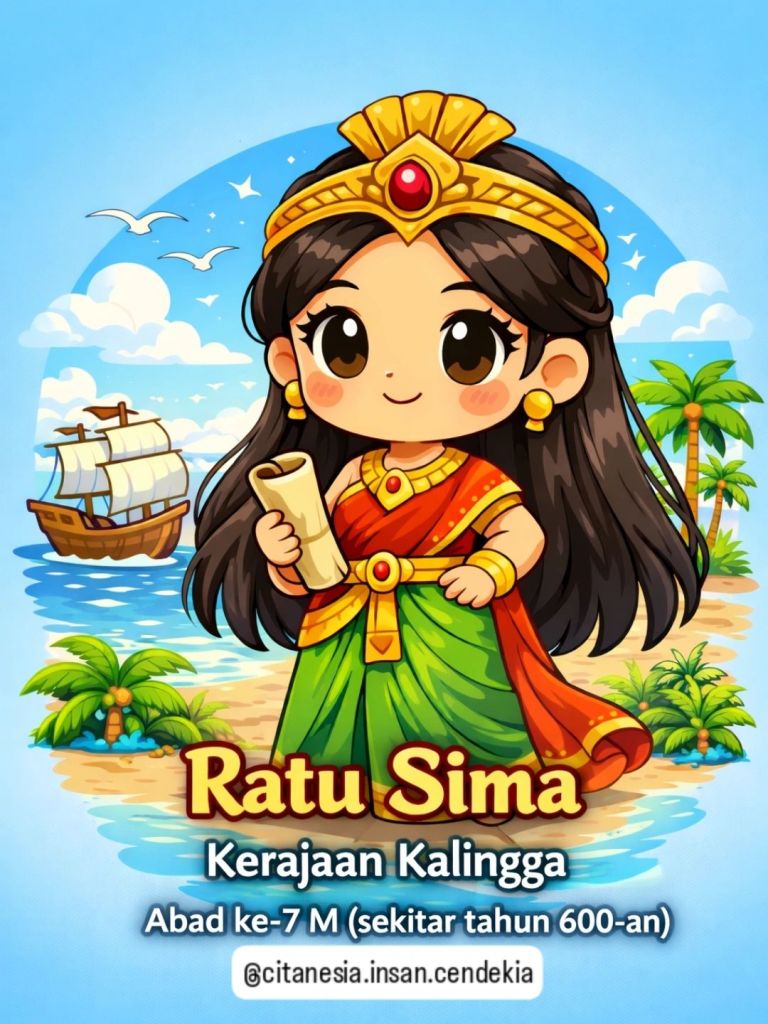
Serial Punggawa Laut: Episode 1 Ratu Sima

The Queen Who Taught a Kingdom to Be Honestejujuran dari Pesisir Jawa

This image is a creative illustration for storytelling and educational purposes


Hello, Friends of Cita & Nesia!

Long, long ago, on the northern coast of Java, there was a kingdom called Kalingga.

It was a place close to the sea.

Ships travelled across the waters. Traders came from distant places. People carried goods, stories, languages, and new ideas from one harbour to another.

And in this busy maritime kingdom lived a remarkable ruler.

Her name was Queen Sima, or Ratu Sima.

Ratu Sima was known for something very important.

She believed that a strong kingdom needed honest people.

Not only honest traders.

Not only honest citizens.

But also honest leaders.

And there is an old story about her that has been remembered for generations.

The Mysterious Bag of Gold

One day, a visitor wanted to find out whether the people of Kalingga were really as honest as everyone said.

So, he placed a bag filled with gold beside a road.

Then he waited.

People walked past it.

Some may have noticed it.

Some may have wondered who had left it there.

But nobody took it.

One day passed.

Then another.

And another.

Still, the bag remained in the same place.

Imagine that!

A bag of gold sitting beside a busy road, and nobody carried it home.

Why?

Because the people knew that something that did not belong to them should not be taken.

Then one day, someone from the royal family passed along the road.

By accident, his foot touched the bag.

When Ratu Sima heard what had happened, she faced a difficult decision.

Should she ignore it because the person belonged to her own family?

Ratu Sima said no.

Rules could not be only for ordinary people.

A leader and her family also had to respect them.

According to the story, Ratu Sima first ordered a very serious punishment. After discussion with her advisers, the punishment was directed only towards the foot that had touched the bag.

The story may sound very strict to us today.

But the message remembered through generations is much simpler:

Honesty matters, even when nobody is watching.

What Does This Have to Do with the Sea?

You might be wondering:

โ€œCita, Nesia, this is a story about a bag of gold. Where is the ocean?โ€

Good question!

Kalingga was part of a world connected through the sea.

Ships could carry spices, ceramics, textiles, food, and many other things.

But successful maritime connections needed something else too.

Trust.

Imagine being a trader arriving by ship in a place you had never visited before.

Would you feel comfortable trading with people you could not trust?

Would you return to a harbour where agreements were often broken?

Probably not.

Ships and ports may connect places physically, but trust connects people.

That is why values such as honesty, fairness, and responsibility can also be part of a maritime society.

A Maritime Mindset Can Begin with Character

Sometimes, when we hear the words maritime nation, we imagine big ships, busy ports, fishing boats, sailors, or naval fleets.

Those things are certainly part of a maritime world.

But CitaNesia invites us to look a little deeper.

A maritime society is also made of people.

And people bring their values wherever they go.

They bring them onto boats.

Into markets.

Across harbours.

Into communities.

And into the decisions they make.

Ratu Simaโ€™s story reminds us that maritime strength is not only about how many ships a country has.

It can also be about the character of the people who live within that maritime world.

CitaNesia Insight

Ratu Simaโ€™s story gives us a simple but powerful lesson:

A maritime mindset is not only about understanding the sea. It is also about developing the values that allow people to live, trade, travel, and work together across it.

Honesty creates trust.

Trust strengthens relationships.

And strong relationships help connect communities across islands and seas.

Indonesiaโ€™s maritime story, therefore, is not only a story of ships, ports, sailors, and oceans.

It is also a story of people and values.

Perhaps that is one of the most important things we can learn from Ratu Sima.

The sea connects our islands.

Character helps connect our people.

A Little Question for KawanCita

Imagine you found something valuable that did not belong to you.

What would you do?

And why do you think honesty is important when people live and work together?

Maybe the first step towards developing a maritime mindset begins with something very small:

learning how to become someone others can trust.

โ€” Cita & Nesia

Part of CitaNesiaโ€™s Serial Punggawa Laut, sharing stories of people, values, and ideas that have shaped the maritime world of the Nusantara.