

The Sultan Who Built Alliances Across the Eastern Seas
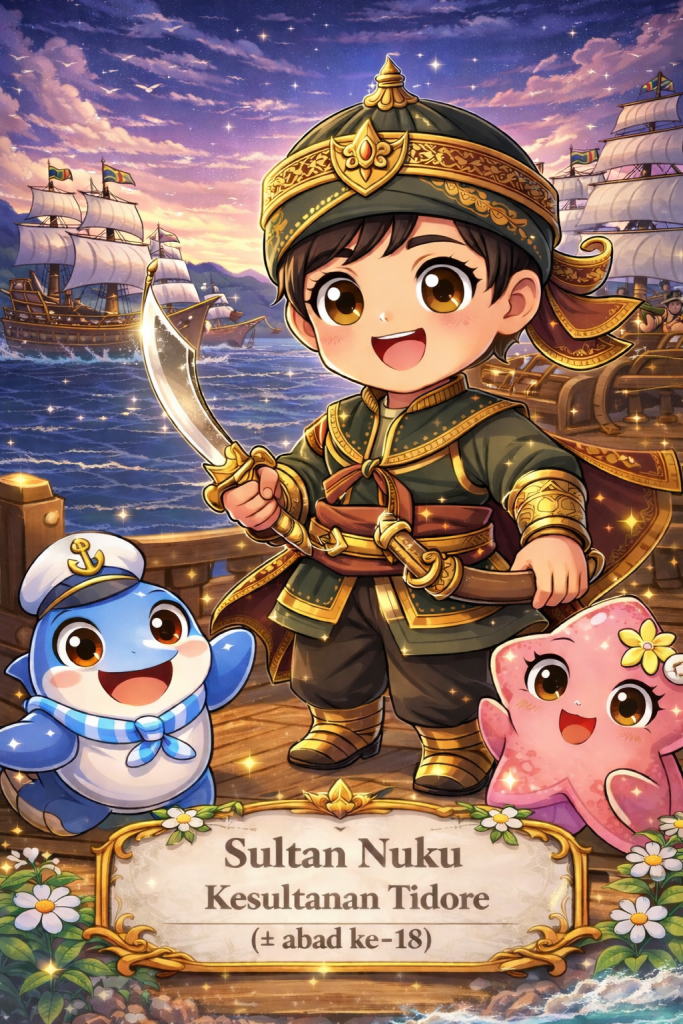
Hello, Friends of Cita & Nesia!
This time, let us travel once again to the beautiful islands of Maluku.
But we are travelling to a different time and meeting a different maritime leader.
Our destination is Tidore.
And our story takes us to the late eighteenth century, more than two hundred years after the time of Sultan Baabullah.
There, among islands surrounded by busy seas, lived a prince who would spend many years resisting foreign control and bringing communities together across a vast maritime world.
His name was Nuku.
He would later become known as Sultan Nuku of Tidore.
A Prince Who Refused to Give Up
Nuku was born into the royal family of Tidore.
His father was Sultan Jamaluddin.
But this was a difficult period for the Sultanate.
European colonial powers had become deeply involved in the politics and spice trade of Maluku, and Dutch influence increasingly affected the affairs of Tidore.
Nuku refused to simply accept this situation.
Around 1780, he emerged as an important leader of resistance.
But there was one big problem.
Nuku did not initially control Tidore itself.
So how could a prince without a secure capital continue a struggle against a powerful colonial company?
This is where his story becomes especially interesting.
He built connections.
The Sea Became His Network
Look at a map of eastern Indonesia.
You will see islands everywhere.
Tidore.
Halmahera.
Seram.
Raja Ampat.
And farther east, Papua.
To someone who thinks only about land, these places may appear separated.
There is water between them.
But Nuku understood the maritime world differently.
The sea could connect them.
He travelled through these maritime networks and gathered supporters from different communities.
Historical accounts describe support connected with Raja Ampat, eastern Seram, parts of Halmahera, and Papua.
His struggle therefore did not depend on only one island.
It grew through relationships across many islands.
Boats carried people.
Boats carried messages.
Boats carried supplies.
And, perhaps most importantly, the sea allowed alliances to grow.
Imagine Leading Without a Telephone
KawanCita, imagine something for a moment.
You want to bring people together across many islands.
But there is:
No telephone.
No internet.
No aeroplane.
No instant messaging.
You cannot simply create a group chat and write:
“Everyone, meeting tomorrow at 9!”
You have to sail.
Messages may take days or longer to arrive.
Weather can change.
The sea can become rough.
And communities may have different interests and leaders.
Yet Nuku managed to maintain relationships across this enormous maritime space for many years.
That required more than bravery.
It required communication, trust, patience and strategy.
Friends in Different Places
Nuku also understood something that good leaders often understand:
Sometimes we need allies.
His supporters did not all come from exactly the same place or background.
Different communities joined his wider struggle at different times.
Nuku also developed relationships with English traders and later benefited from British support as he challenged Dutch power in the region.
This makes his story particularly interesting.
He was not simply fighting battles.
He was navigating a complicated world of:
local communities,
island rulers,
trading networks,
European powers,
and changing alliances.
A good maritime leader had to understand all of them.
Returning to Tidore
Nuku’s struggle lasted for many years.
There were successes.
There were setbacks.
There were moments when his position became weaker.
But he continued.
Eventually, his alliances and persistence helped him regain Tidore.
By 1797, Nuku had established himself as Sultan of Tidore.
After so many years of struggle, he had returned not simply as a prince seeking a throne, but as a leader supported by a broad maritime network.
He continued ruling until his death in 1805.
Today, Sultan Nuku is remembered as one of Indonesia’s National Heroes.
A Kingdom Larger Than One Island
Here is something very important about the story of Tidore.
When we hear “Sultanate of Tidore”, we might imagine only the small island of Tidore.
But historically, Tidore’s relationships extended much farther.
Its political and cultural connections reached parts of Halmahera, Seram, Raja Ampat and Papua.
This helps us understand something important about maritime history.
A maritime kingdom does not always look like a large block of land on a map.
Its world can be made of routes and relationships.
One island connects with another.
One community communicates with another.
One harbour opens a pathway towards another sea.
The water between them is not necessarily an empty space.
The water is part of the network.
What Made Sultan Nuku Strong?
Was it simply because he had ships?
No.
Was it simply because he could fight?
No.
Nuku’s strength also came from his ability to maintain relationships.
His story highlights several qualities:
Persistence — he continued his struggle for many years despite setbacks.
Strategy — he understood that different situations required different approaches.
Alliance-building — he brought together communities across a wide maritime area.
Adaptability — he worked within a complicated world of changing political relationships.
Maritime knowledge — he understood that islands and seas formed an interconnected political landscape.
These are very different forms of strength.
CitaNesia Insight
Sultan Nuku’s story teaches us something especially important about a maritime mindset:
You do not always become stronger by standing alone.
Sometimes strength comes from knowing how to connect.
An island may be small.
But connect it with another island, and the network becomes larger.
Connect communities.
Share knowledge.
Build trust.
Maintain relationships.
Suddenly, distance does not necessarily mean isolation.
This was one of the remarkable features of Nuku’s maritime world.
The seas of eastern Nusantara did not merely surround his struggle.
They made his network possible.
His story therefore gives us four important maritime values:
Persistence — keep moving even when the journey becomes difficult.
Connection — recognise that relationships can cross seas and distances.
Strategy — think carefully rather than relying only on strength.
Unity in diversity — people from different communities can work together when they find a shared purpose.
A Little Question for KawanCita
Imagine you have a very difficult problem.
Would you rather solve everything completely alone?
Or could you ask:
“Who might know something that I don’t?”
“Who could help?”
“And what could I contribute in return?”
Asking for help does not necessarily make us weaker.
Sometimes knowing how to build a good team is itself a form of leadership.
That may be one of the most interesting lessons we can learn from Sultan Nuku.
He lived in a world of many islands.
Many communities.
Many interests.
And many challenges.
Yet he understood that the spaces between islands did not have to keep people apart.
The sea could become the pathway that brought them together.
— Cita & Nesia
Part of CitaNesia’s Serial Punggawa Laut, sharing stories of people, values, and ideas that have shaped the maritime world of the Nusantara.

