

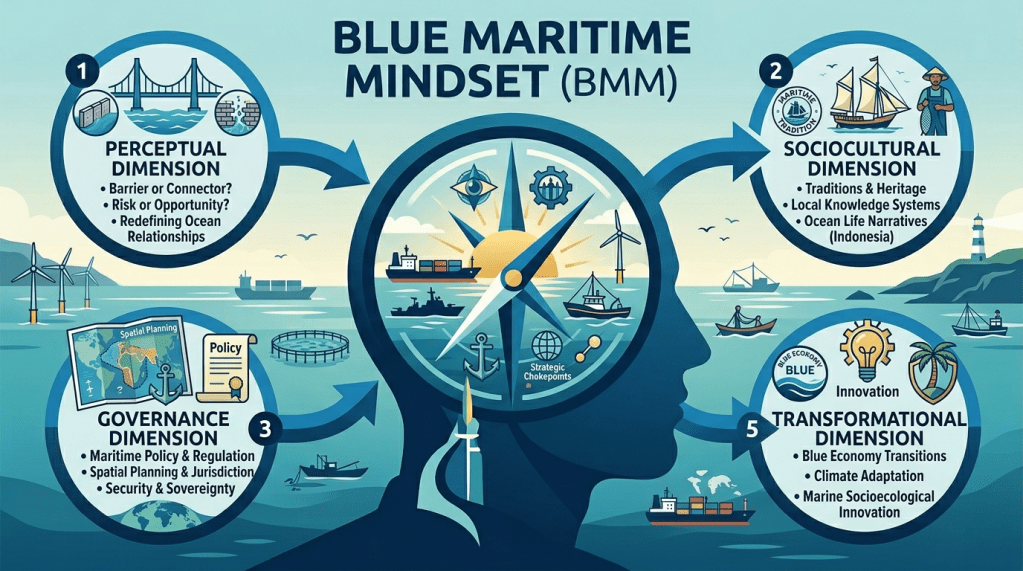
Blue Maritime Mindset (BMM)
A Conceptual Foundation within GlossaryNesia
Introduction
Within GlossaryNesia, the Blue Maritime Mindset (BMM) is introduced as a foundational concept to reframe how we understand the sea. Rather than viewing the ocean as a passive geographical space, BMM positions it as an active system of connection, identity, and strategic influence.
This mindset is particularly relevant in the context of Indonesia, where the sea is not a boundary between islands, but the very element that binds the nation together.
What is Blue Maritime Mindset?
Blue Maritime Mindset (BMM) is a cognitive and sociocultural framework that shapes how individuals, communities, and institutions perceive and engage with the maritime domain.
It expands conventional maritime perspectives by integrating:
Cognitive awareness of the sea as a living system
Cultural meaning embedded in maritime identity
Governance structures that organise ocean space
Strategic understanding of maritime connectivity and flows
In this framework, the sea becomes a dynamic medium—not only for transportation or resources, but also for energy, influence, and continuity.
How is BMM Constructed?
The construction of the Blue Maritime Mindset is layered and integrative. It emerges through the interaction of five key dimensions:
1. Perceptual Dimension
This dimension concerns how the sea is understood at the level of mindset:
Is it seen as a barrier or a connector?
As a risk or an opportunity?
Shifts at this level redefine how societies relate to maritime space.
2. Sociocultural Dimension
This dimension reflects how the sea is embedded in identity:
Maritime traditions and heritage
Local knowledge systems
Narratives and symbols of ocean life
For Indonesia, this dimension is central to reinforcing its archipelagic identity.
3. Governance Dimension
This dimension translates mindset into institutional practice:
Maritime policy and regulation
Spatial planning and jurisdiction
Security and sovereignty frameworks
It determines how maritime space is managed and protected.
4. Connectivity Dimension
This dimension highlights the sea as a system of flows:
Trade and logistics routes
Energy distribution pathways
Global interdependence through maritime networks
Strategic chokepoints, such as international straits, illustrate how the sea operates as a global circulatory system.
5. Transformational Dimension
This dimension looks toward the future:
Blue economy transitions
Climate adaptation and resilience
Innovation in marine socioecological systems
It positions BMM as a mindset for navigating uncertainty and change.
Why BMM Matters
The Blue Maritime Mindset provides a strategic lens to:
Reposition the sea as the centre of national identity and development
Strengthen maritime governance and policy coherence
Integrate local wisdom with global maritime systems
Recognise the ocean as a medium of energy, connectivity, and resilience
For Indonesia, adopting BMM is not optional—it is essential for unlocking its full maritime potential.
Closing Reflection
Within GlossaryNesia, BMM serves as a conceptual anchor. It bridges knowledge, identity, and practice—allowing maritime thinking to evolve beyond fragmented perspectives into a more integrated and meaningful understanding of the ocean.
✍🏽: Founder of Citanesia
📧 : citanesia.insan.cendekia@gmail.com

