

The Sultan Who Defended the Spice Islands
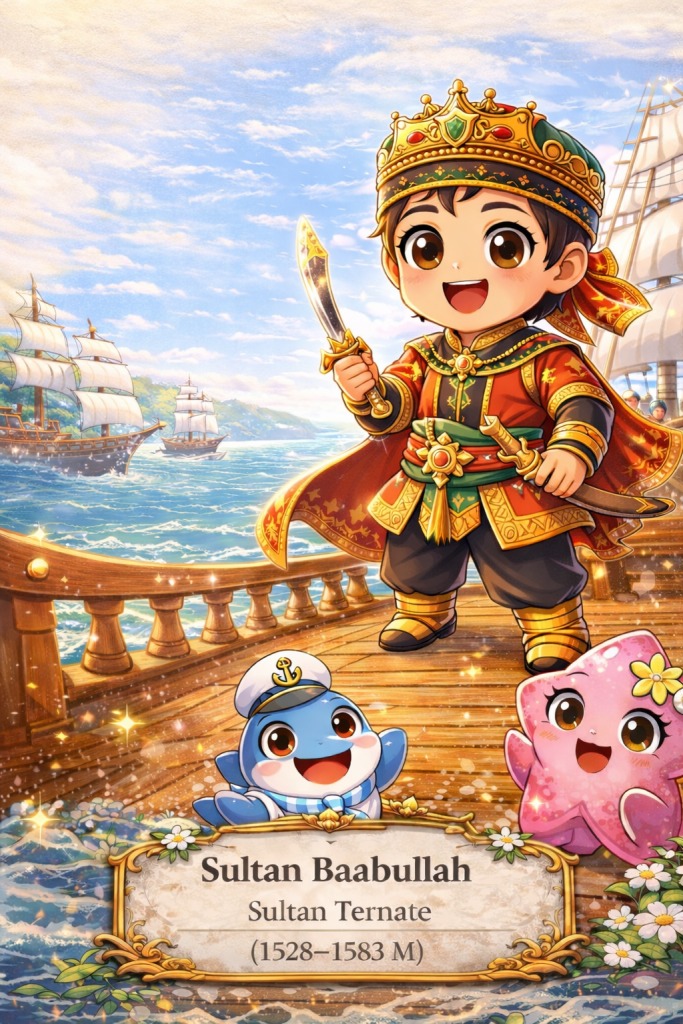
Hello, Friends of Cita & Nesia!
This time, let us travel to the eastern part of the Nusantara.
Far across the sea, among the beautiful islands of Maluku, there was once a powerful maritime kingdom called Ternate.
The islands were small.
But their importance was enormous.
Why?
Because they were home to something the world greatly desired:
spices.
Cloves from Maluku travelled across the seas and reached distant lands.
Ships came from many places.
Traders arrived.
Foreign powers also came.
And in the middle of this busy maritime world stood a remarkable leader.
His name was Sultan Baabullah.
The Sultan of Ternate
Sultan Baabullah ruled Ternate during the sixteenth century.
He was known as a determined leader who understood that protecting his kingdom meant protecting not only the land, but also the surrounding seas.
For island communities, the sea was everything.
It was a road.
A source of food.
A trading route.
A connection between islands.
And sometimes, it was also a place that needed to be defended.
During Sultan Baabullah’s time, the Maluku Islands had become one of the most important centres of the global spice trade.
That brought prosperity.
But it also brought competition.
Foreign powers wanted access to the valuable spices and control over important maritime routes.
For Ternate, this created a difficult challenge.
When Foreign Powers Came
Among the foreign powers present in the region were the Portuguese.
Relations between Ternate and the Portuguese changed over time and eventually became deeply hostile.
Sultan Baabullah inherited a period of serious conflict.
Instead of giving up, he organised resistance.
But he did not act alone.
His strength depended on people.
Communities.
Allies.
And networks across the islands.
That is important.
Because defending a maritime kingdom spread across many islands could never be the work of one person.
It required unity.
A Struggle Across the Sea
Imagine trying to protect a kingdom made up of islands.
There are no highways connecting them.
No trains.
No cars travelling from one island to another.
The sea is the highway.
Messages travel by boat.
People travel by boat.
Food travels by boat.
And warriors travel by boat.
This meant that maritime knowledge was essential.
Leaders needed to understand routes, islands, alliances, and the movement of people across the sea.
Sultan Baabullah used these connections as part of a long campaign against the Portuguese presence in Ternate.
After years of conflict, the Portuguese were forced to leave their fort in Ternate in 1575.
For Ternate, this was a major victory.
Why Was Baabullah Called the Ruler of 72 Islands?
Sultan Baabullah later became associated with the title “Ruler of 72 Islands.”
What does that mean?
It does not necessarily mean that he personally stood on every island giving orders.
It reflects the wide network of influence connected to Ternate during his reign.
Across eastern Nusantara, political relationships were often built through islands, trading routes, alliances, tribute, family relationships, and maritime connections.
The sea helped hold these networks together.
This gives us an important lesson.
A maritime kingdom is not always shaped like a land kingdom.
Its strength can come from connections across water.
One island may be separated from another geographically, but maritime relationships can bring them together politically, economically, and socially.
The Spice Islands and the Wider World
There is something else fascinating about Sultan Baabullah’s story.
The history of Ternate was not happening only in one small corner of the world.
Maluku was connected to something much larger.
Spices from these islands travelled enormous distances.
They became part of trade networks linking Southeast Asia with other regions.
This means that communities living in relatively small islands could have enormous importance in global history.
Isn’t that amazing?
Sometimes we look at a map and think that a small island must also have a small story.
But maritime history teaches us otherwise.
A small island can sit at the centre of a very large network.
What Makes a Maritime Leader Strong?
Sultan Baabullah’s story is often remembered because of resistance and military victory.
But CitaNesia invites us to look a little deeper.
How could a leader maintain influence across many islands?
Physical strength alone would not be enough.
A maritime leader also needed:
Strategy — understanding when and how to act.
Unity — bringing different communities together.
Knowledge — understanding people, places, routes, and relationships.
Determination — continuing even when a struggle became difficult.
These qualities helped turn separate communities into a stronger network.
CitaNesia Insight
Sultan Baabullah reminds us that a maritime mindset can also be about understanding interdependence.
One island cannot always stand alone.
Communities depend on other communities.
Ports depend on maritime routes.
Trade depends on relationships.
And leaders depend on the trust and support of people.
Sultan Baabullah’s story therefore offers us several important maritime values:
Courage — standing firm when something important must be protected.
Unity — recognising that collective strength can be greater than individual strength.
Strategy — thinking carefully before acting.
Connection — understanding that islands become stronger when relationships across the sea remain strong.
His story also reminds us of something important about Indonesia.
The sea does not make islands isolated.
The sea can make islands part of a network.
A Little Question for KawanCita
Imagine you are given one stick.
It might break easily.
Now imagine many sticks tied together.
Would they be harder to break?
Communities can be like that too.
When people stand alone, challenges can feel very large.
But when people cooperate, share knowledge, and help one another, they can become much stronger.
That is one lesson we can take from Sultan Baabullah and the maritime world of Ternate:
Strength does not always come from being the biggest. Sometimes it comes from being connected.
And perhaps that is one of the greatest lessons the islands of the Nusantara can teach us.
— Cita & Nesia
Part of CitaNesia’s Serial Punggawa Laut, sharing stories of people, values, and ideas that have shaped the maritime world of the Nusantara.

