
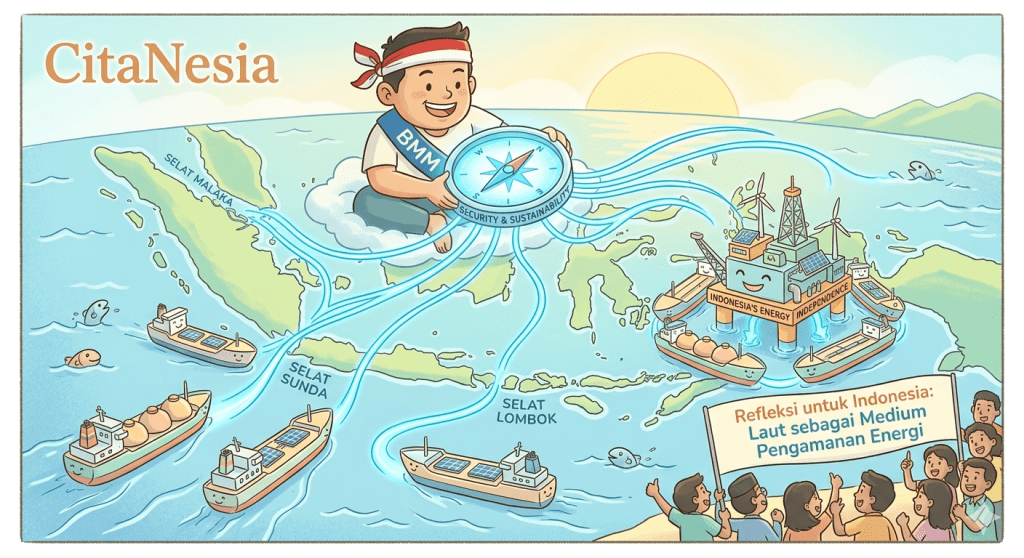
In today’s global landscape, the sea is increasingly recognised not merely as a geographical space, but as a strategic domain for energy security.
Global dependence on maritime routes for the movement of energy commodities—particularly oil and gas—means that the stability of sea lanes has become closely linked to economic resilience, geopolitical stability, and international security.
Developments around major maritime chokepoints, including the Strait of Hormuz, illustrate how disruption in one part of the maritime system can have consequences far beyond the immediate region. A disturbance at sea can affect shipping, energy prices, supply chains, and the wider global economy.
From this perspective, the sea is more than a transport corridor.
It is part of an interconnected system linking energy, security, trade, geopolitics, and governance.
For Indonesia, this has particular significance.
As the world’s largest archipelagic state, Indonesia occupies a strategic position within regional and global maritime connectivity. Important sea lanes pass through and around the Indonesian archipelago, including the Strait of Malacca, Sunda Strait, and Lombok Strait.
This position creates opportunities, but it also brings responsibilities.
Maintaining safe, stable, and well-governed maritime spaces is important not only for Indonesia’s national interests, but also for the wider regional system that depends on these routes.
At the same time, Indonesia’s relationship with energy and the sea extends beyond maritime transport.
Indonesia’s marine and coastal spaces also contain energy potential of their own. Alongside offshore oil and gas resources, emerging marine renewable energy technologies—including tidal, wave, current, and other ocean-based energy systems—offer possibilities for diversifying the country’s future energy landscape.
This creates an important strategic question:
Can Indonesia move from seeing the sea primarily as a route through which energy passes, towards understanding it as part of a broader national energy system?
Through the perspective of the Blue Maritime Mindset (BMM), CitaNesia views energy security as inseparable from the way society understands the sea.
The sea should not be viewed only as infrastructure, territory, or a source of commodities.
It can also be understood as an integrated maritime space in which security, sustainability, economic resilience, environmental responsibility, and national identity intersect.
Such a perspective encourages Indonesia to think beyond the role of a passive user of global maritime routes.
Indonesia has the potential to strengthen its role as a maritime actor capable of governing, safeguarding, and strategically developing its marine spaces as part of a changing regional and global energy system.
This does not mean that maritime energy development should be pursued without limits.
Energy security and maritime development must also be considered alongside ecosystem protection, coastal communities, technological capacity, governance, and long-term sustainability.
The future of energy at sea is therefore not only a technological or economic question.
It is also a question of how Indonesia chooses to understand, govern, and value its maritime space.
CitaNesia Insight
A maritime mindset allows us to see that energy security does not begin and end with ships carrying fuel across the ocean.
It also involves the resilience of sea lanes, the governance of strategic waters, the sustainability of marine resources, and the capacity to develop future energy systems responsibly.
For an archipelagic country such as Indonesia, the sea is not simply where energy moves.
It can also become part of how energy security is imagined, governed, and strengthened.
Further exploration of this topic will continue through future KristaNesia publications as part of CitaNesia’s contribution to strengthening Indonesia’s strategic maritime thinking.
Salam Cita!