The Sea Between Us, or the Sea That Connects Us?

When looking at a map of Indonesia, it is easy to notice the spaces between the islands.

Blue stretches of water appear to separate Sumatra from Java, Java from Kalimantan, Sulawesi from Maluku, Maluku from Papua, and thousands of smaller islands from one another.

From a land-centred perspective, the sea can look like a gap.

A distance.

Something that must be crossed before reaching somewhere else.

But what if we looked at it differently?

What if, for many communities across the Indonesian archipelago, the sea was never simply the space between places?

What if it was one of the things that connected them?

When Water Was a Pathway
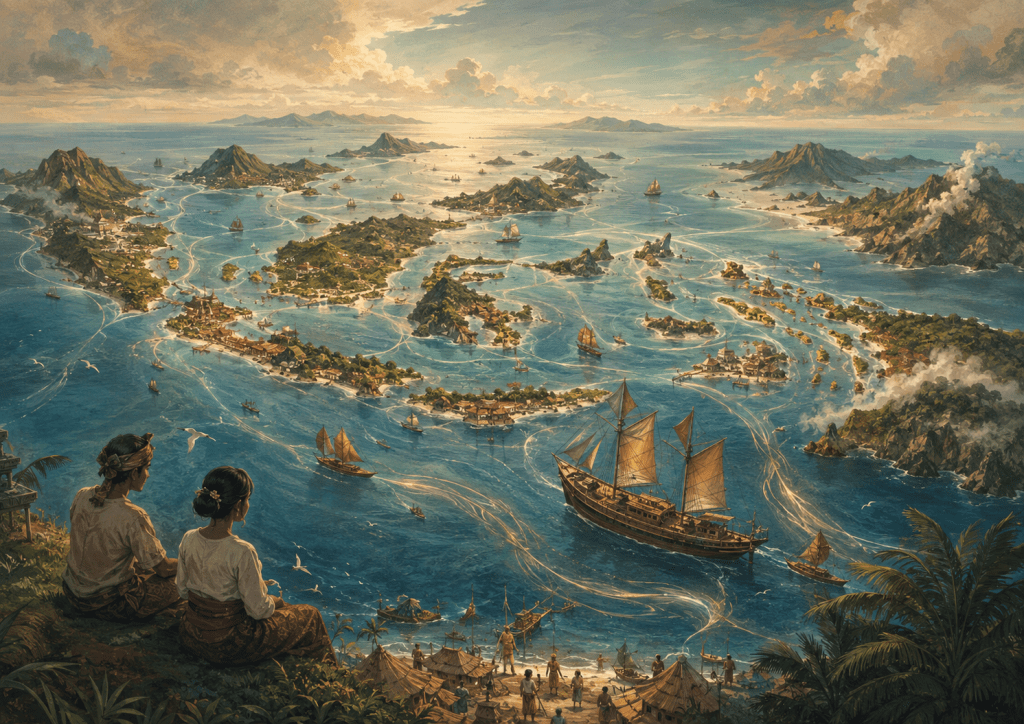
This image is an artistic illustration created for this post. It is not an accurate or official map of Indonesia, but a symbolic representation of the archipelago and the sea as a space of connection.

Long before modern roads, airports and administrative boundaries shaped the way we imagine Indonesia, people travelled through the archipelago by water.

Boats carried people, food, tools, stories, languages, beliefs and knowledge.

Coastal settlements and ports became meeting places. People did not only exchange goods; they encountered different communities and ways of understanding the world.

These maritime connections extended across the archipelago, from the western islands of Sumatra and Java, through Kalimantan, Sulawesi and Maluku, and eastward towards Papua.

In this sense, the sea was not empty space.

It was a pathway.

The movement of people across water created relationships between places that might appear distant when viewed from land.

A community on one island could have social, cultural or economic connections with another community across the sea.

The coastline was not necessarily the end of someone’s world.

Sometimes, it was where another world began.

Islands Do Not Always Mean Isolation

Today, we often describe Indonesia as a country made up of thousands of islands.

The description is geographically correct, but the way we imagine those islands matters.

If we see every island as an individual piece of land surrounded by water, we may unconsciously imagine Indonesia as a collection of separated territories.

But an archipelago can also be understood as a network.

Within that network, the sea is part of the connection.

People navigate through it.

They depend upon it.

They learn its seasons, currents and winds.

They build livelihoods around it.

And through generations of movement, maritime routes can become social and cultural routes as well.

This is also important when thinking about eastern Indonesia. Maluku and Papua should not be imagined simply as distant edges of the map. They are part of wider maritime worlds shaped by movement, exchange, coastal relationships and connections extending across surrounding seas.

Perhaps this is one reason why understanding Indonesia only from the land gives us an incomplete picture.

The Sea Carries More Than Boats

The sea has carried much more than vessels.

It has carried language.

Food.

Music.

Family connections.

Trade.

Migration.

Religious ideas.

Technology.

Stories.

And memories.

Across generations, these movements contributed to the extraordinary diversity that exists throughout Nusantara, including the many distinctive coastal and island communities of eastern Indonesia and Papua.

Different places maintained their own identities, yet they were rarely completely disconnected from the worlds around them.

The sea allowed encounters to happen.

Sometimes peacefully.

Sometimes competitively.

Sometimes through migration, trade, political expansion or conflict.

Maritime connection does not mean that the history of the archipelago was always harmonious.

But it reminds us that water has continually participated in shaping relationships between people and places.

Changing the Way We Look at the Map

Perhaps we can try a small exercise.

Look at a map of Indonesia again.

This time, instead of looking first at the islands, look at the blue.

Look at the Malacca Strait.

The Java Sea.

The Makassar Strait.

The Flores Sea.

The Banda Sea.

The Arafura Sea.

The waters surrounding Maluku and Papua.

And the many other seas and straits that weave around and between the islands.

Suddenly, the map can tell a slightly different story.

The water does not disappear.

It becomes part of the geography we pay attention to.

And when we begin recognising the sea as a space of movement, memory and interaction, Indonesia starts to look less like scattered pieces of land and more like an interconnected maritime world stretching from Sumatra to Papua.

What Does This Mean for Maritime Identity?

Being an archipelagic country does not automatically mean that everyone identifies with the sea.

Many Indonesians grow up far from the coast. Their everyday lives may be shaped more strongly by farms, mountains, cities, rivers or forests.

This is particularly important in a country as geographically and culturally diverse as Indonesia, where communities in places such as the highlands of Papua may have relationships with landscape that are very different from those of coastal communities.

Maritime identity therefore does not need to mean that every Indonesian must think like a sailor.

Perhaps it can mean something broader.

It can begin with recognising that the sea has played an important role in shaping the relationships between our islands, communities and histories.

The sea can be understood not only as a resource to use or a boundary to defend, but also as part of the cultural and geographical fabric that has connected people across Nusantara.

And perhaps that changes one simple question.

Instead of asking:

What separates one Indonesian island from another?

We might also ask:

What has connected them?

Sometimes, the answer has always been there—

flowing quietly between the shores.

The sea.

The Sea as a Way of Thinking: Learning from Indonesia’s Maritime Communities

Indonesia is often described as a maritime nation. Thousands of islands are connected by seas, straits, coastal settlements, trading routes, fishing grounds, and generations of human movement across the archipelago.

Yet a maritime nation is not created by geography alone.

Being surrounded by the sea does not automatically mean that people think about the sea as part of their everyday identity. A maritime mindset develops through relationships: through experience, knowledge, memory, livelihood, culture, and repeated interaction with marine environments.

Across Indonesia, many coastal, island, and sea-oriented communities have maintained particularly close relationships with the ocean. For some communities, the sea is not something located at the edge of life. It is part of life itself.

People live beside it, travel across it, learn its rhythms, depend upon its resources, pass knowledge about it between generations, and incorporate it into social and cultural practices.

This offers an important way of thinking about maritime mindset.

When the Sea Is Part of Everyday Life

A maritime mindset does not necessarily begin with formal maritime education or national policy.

It can begin much more quietly.

It may grow through a child watching family members prepare a boat, learning when the tide changes, recognising different winds, listening to stories about particular islands or fishing grounds, or understanding that weather conditions influence when people can travel.

Through experiences like these, the sea becomes more than a physical environment.

It becomes familiar.

It becomes meaningful.

And, over time, this familiarity can influence how people understand their place within the wider world.

Indonesia’s coastal and sea-oriented communities demonstrate that relationships with the ocean can become deeply embedded in everyday knowledge and social life. Communities such as the Sama-Bajau, for example, are frequently associated with long histories of maritime mobility and close relationships with marine environments across parts of maritime Southeast Asia.

Their experiences should not be simplified into a single image of “sea people”. Communities are diverse, contemporary, and continually changing. Nevertheless, their long-standing relationships with marine environments remind us of something important:

Maritime thinking can be cultivated through living relationships with the sea.

Maritime Mindset Beyond Coastal Communities

This does not mean that everyone in Indonesia needs to live beside the ocean or adopt the lifestyles of maritime communities.

Instead, these communities can inspire a broader question:

What can the rest of us learn from people who have never treated the sea as distant from everyday life?

Perhaps maritime mindset begins with recognising connection.

Someone living hundreds of kilometres from the coastline may still depend upon maritime transportation, seafood supply chains, ocean climate systems, ports, coastal ecosystems, or economic activities connected with the sea.

The relationship may be less visible, but it still exists.

Developing a maritime mindset therefore does not require everyone to become a sailor, fisher, marine scientist, or coastal resident.

It requires recognising that the sea matters.

It means becoming more aware of how maritime environments connect communities, livelihoods, cultures, economies, histories, and futures.

From Maritime Heritage to Maritime Awareness

Indonesia possesses extraordinary maritime traditions. But maritime heritage becomes especially meaningful when it continues to inform how contemporary society understands the ocean.

Traditional and Indigenous knowledge can therefore offer more than historical stories. It can remind wider society that relationships with marine environments have long been forms of knowledge in themselves.

Observing currents, seasons, weather, species, navigation routes, coastal changes, and marine conditions requires attentiveness developed through repeated interaction with place.

Such relationships demonstrate that maritime knowledge is not produced only inside universities, government institutions, or research organisations.

Knowledge also lives within communities.

It travels through generations.

It grows through practice.

And it develops through continuous relationships between people and their environments.

A Maritime Mindset for a Wider Indonesia

Perhaps one challenge for a large archipelagic country is ensuring that the ocean remains present in the minds of people even when it is not visible from where they live.

Indonesia’s maritime communities offer an important source of inspiration.

They remind us that the sea does not have to remain somewhere beyond the shoreline.

It can become part of how people understand connection, responsibility, heritage, livelihood, and belonging.

A maritime mindset does not require everyone to share the same maritime identity. Different communities will experience the ocean differently, and those differences are part of Indonesia’s richness.

What matters is maintaining an awareness that the sea is not simply the space separating Indonesia’s islands.

It is also one of the spaces that connects them.

Perhaps strengthening Indonesia’s maritime future therefore begins not only with ports, ships, policies, or infrastructure.

It also begins in the mind.

By listening to communities whose relationships with the sea have endured across generations, Indonesia can continue learning how maritime awareness might grow far beyond the shoreline—and remain present within the wider national imagination.

CitaNesia Reflection — Maritime Mindset

This reflection forms part of CitaNesia’s exploration of how maritime ways of thinking can grow through culture, knowledge, experience, and everyday relationships with the sea. It does not suggest that Indonesia has one single maritime identity; rather, it recognises the diversity of relationships through which people understand and experience the ocean.